 blog
Gas Safety Compliance vs Heating Maintenance: A Landlord Guide
Last Updated: October 23, 2026
Quick Summary
Gas safety compliance is the legal duty to have every gas appliance and flue checked every 12 months by a Gas Safe registered engineer and to give tenants the record within 28 days. Reliable heating maintenance is separate work that keeps the boiler running, so book a boiler service alongside the annual check to protect the warranty and avoid emergency call-outs.
- Keep gas safety check records for at least two years and give tenants a copy within 28 days.
- A CP12 confirms appliances were safe on inspection day, not that the boiler will keep running.
- Many manufacturers require an annual service to keep the boiler warranty valid.
- If a tenant smells gas, they should call the National Gas Emergency Service on 0800 111 999.
- For a standard no-heat report, respond within 4 working hours and attend same or next working day.
Table of Contents
- Gas Safety Compliance vs Reliable Heating Maintenance: What Landlords Need to Know
- Landlord Gas Safety Check Frequency and Legal Duties
- Boiler Service vs Gas Safety Check: Why You Need Both
- Emergency Boiler Repair for Landlords: Triage, Response Times and Tenant Communication
- Heating Maintenance Checklist for Rental Properties
- What to Do When a Gas Appliance Is Unsafe or a Tenant Reports No Heating
- Preventive Maintenance vs Statutory Inspection: Balancing Cost and Compliance
- Frequently Asked Questions
Gas Safety Compliance vs Reliable Heating Maintenance: What Landlords Need to Know
Gas safety compliance is the legal duty to have gas appliances and flues checked every 12 months by a Gas Safe registered engineer and to give tenants a copy of the record.
At Central Heating Scotland, we see how often the two get confused. A landlord holds a valid certificate and assumes the heating is fine. A CP12 proves the appliances were safe on inspection day, not that the boiler will survive a cold snap.
Below, we break down what the law requires, why a boiler service and a gas safety check differ, and how to handle an urgent heating repair without letting either duty slip.
Landlord Gas Safety Check Frequency and Legal Duties
Landlords must arrange a gas safety check every 12 months for every gas appliance, flue and pipework, carried out by a Gas Safe Register engineer. Give the tenant a copy of the record within 28 days and keep your own copy for at least two years (Gas safety check records and what to keep).
A few duties trip landlords up:
- New tenancies: give the new tenant the record before they move in, or at the latest on the day they do.
- Existing tenancies: issue the record within 28 days of each annual check.
- Records: keep them for two years. Letting agents should hold copies too.
The rules are set out in the Gas Safety (Installation and Use) Regulations and enforced by the Health and Safety Executive. Non-compliance can bring fines and, in serious cases, prosecution. It also leaves you exposed if a tenant is harmed.
Boiler Service vs Gas Safety Check: Why You Need Both
A gas safety check tests whether appliances are safe to use. A boiler service cleans, tests and tunes the boiler so it runs efficiently and stays reliable.
Here's the difference in plain terms:
| Feature | Gas Safety Check (CP12) | Boiler Service |
|---|---|---|
| Legal requirement | Yes, every 12 months | No, but strongly advised |
| Purpose | Confirms appliances are safe | Keeps boiler running efficiently |
| Covers | All gas appliances, flues, pipework | The boiler and its components |
| Protects warranty | No | Yes, usually a condition |
| Frequency | Every 12 months | Annually, ideally |
| Who does it | Gas Safe registered engineer | Gas Safe registered engineer |
Many manufacturers require an annual service to keep the warranty valid, skip it and a repair bill could land on you. Book both at the same visit to save a second appointment and access request.
Emergency Boiler Repair for Landlords: Triage, Response Times and Tenant Communication
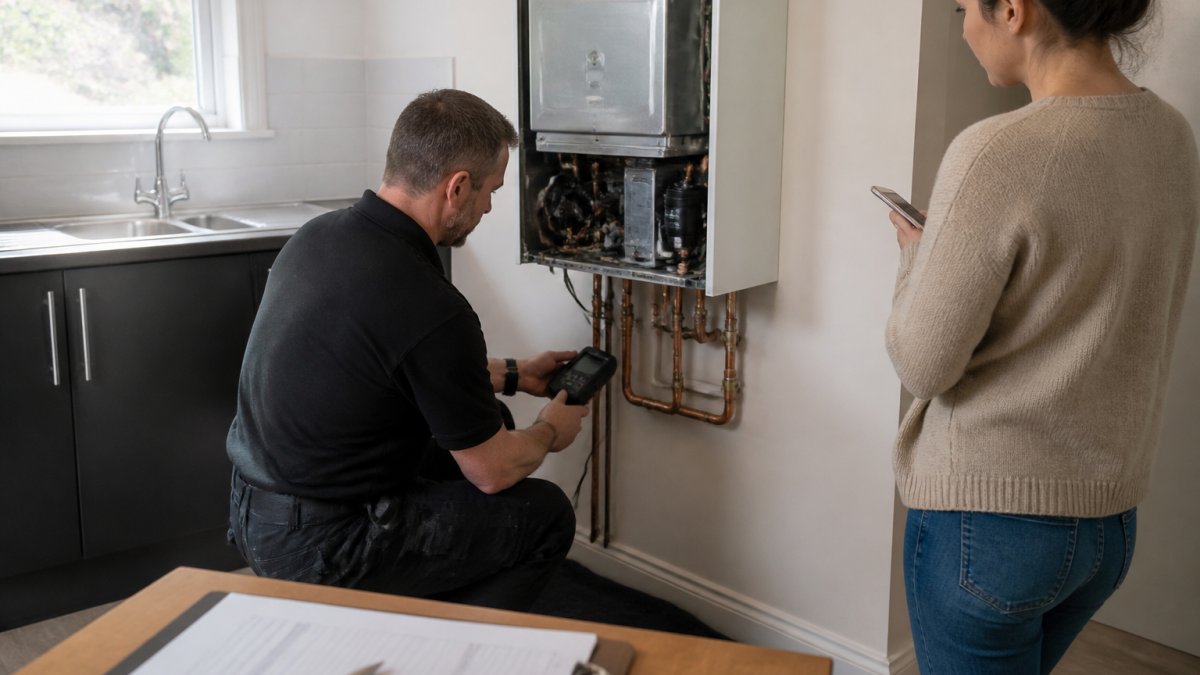
No heating or hot water is not a legal emergency like a gas leak, but it still needs a fast, calm response. The mistake landlords make is treating every no-heat call as identical. Triage separates a genuine safety emergency from a service failure.
Step 1: Safety triage before anything else
Ask three questions, in this order, every time a tenant reports a heating problem:
- Is there a smell of gas? If yes, the tenant should open windows, avoid touching electrical switches, leave the property, and call the National Gas Emergency Service on 0800 111 999. The landlord should not attend or attempt anything. This is a gas emergency, not a repair.
- Is a carbon monoxide alarm sounding, or are there symptoms such as headaches, dizziness or nausea? Treat as a CO incident: evacuate, call the emergency line, and seek medical advice. Do not re-enter until cleared.
- Is there heat or hot water at all, and is the boiler showing a fault code or lockout? If there is no safety signal, this is a service failure and moves to the repair path.
Only after those three questions are answered should you book an engineer. Skipping triage is how landlords send a repair engineer to a gas leak, or tell a tenant to 'wait until Monday' when they should have called the emergency line.
Step 2: Set and publish a response standard
A response standard is a written promise about how quickly you will act for each category. It protects tenants and gives you a defensible position if a complaint escalates:
| Report type | First response | Engineer attendance target |
|---|---|---|
| Gas smell or CO alarm | Immediate, tenant calls 0800 111 999 | Emergency service, not you |
| No heating or hot water (vulnerable tenant) | Within 2 hours | Same day where possible |
| No heating or hot water (standard) | Within 4 working hours | Same day or next working day |
| Partial fault (some radiators cold, intermittent hot water) | Within 1 working day | Next available appointment |
| Cosmetic or minor issue | Within 3 working days | Scheduled visit |
Publish the standard in the tenancy pack and on your landlord portal. Tenants who know it are less likely to escalate and more likely to report accurately.
Step 3: Communicate in a fixed pattern
Every urgent repair should generate the same message sequence:
- Acknowledgement, within the first-response window, confirming the report, the category, and the next step.
- Appointment confirmation, engineer name, Gas Safe licence number, arrival window, and what the tenant should do (clear access, secure pets, leave the boiler accessible).
- On-the-day update, a short message if the engineer is running late, with a revised window.
A short message confirming the appointment time and engineer name reduces panic and repeat calls. Document each contact in the property file, with date and time.
Step 4: Escalate when the standard is at risk
Escalation is not about blame; it is about making sure a vulnerable tenant is not left cold because a contractor is busy. Set a trigger: if the first-response window passes without an engineer booked, call the contractor directly, then a second contractor, and record both attempts. If a vulnerable occupant is affected and the repair will run past 24 hours, arrange temporary heating, fan heaters, an immersion heater where fitted, or alternative accommodation as a last resort, and record the decision and cost.
What this section is not
None of the above replaces the annual gas safety check. A repair visit is not an inspection, and an inspection is not a repair. Keep the records separate: the CP12 in the compliance file, the repair work order and invoice in the maintenance file. In a dispute, the landlord who can produce both, certificate and dated repair trail, is far stronger than one with only the certificate.
Heating Maintenance Checklist for Rental Properties
A simple annual routine keeps the heating reliable and the paperwork clean. Use this checklist each year:
- Book the annual gas safety check before the certificate expires
- Book a boiler service at the same visit
- Check boiler pressure and top up if needed
For landlords managing multiple properties, a shared spreadsheet or property management tool keeps dates and documents in one place. The Gas Safe Register lets you verify an engineer's credentials before booking, so you're never relying on a claim alone.
What to Do When a Gas Appliance Is Unsafe or a Tenant Reports No Heating
If an engineer finds an unsafe appliance, they will usually cap it off or isolate it and issue a warning notice. Your duty is to act on that notice promptly and not reconnect or use the appliance until the fault is fixed and re-checked. Understand what the engineer has done and what evidence to keep.
Reading the engineer's notice
A Gas Safe registered engineer who identifies an unsafe situation will typically take one of two actions:
- Isolation, the appliance is shut off, often at a valve, and labelled. This is the lighter step and is used where the risk is contained by stopping use.
- Capping, the gas supply to the appliance is physically disconnected and capped. This is more definitive and usually means the appliance cannot be used until a qualified engineer reconnects it after remedial work.
The engineer will leave a warning notice describing the fault and action taken. Keep the original, photograph it, and note the engineer's name and Gas Safe licence number. If the notice says the appliance should not be used, that is not optional, a tenant using a capped or isolated appliance is a serious risk and may invalidate insurance.
The landlord's action sequence
Work through this order and record each step with a date:
- Confirm the safety action, check the notice and confirm the appliance is isolated or capped. Do not attempt to reset, relight or reconnect it yourself.
- Tell the tenant in writing, explain what has been done, why, and what they must not do. Keep a copy.
- Arrange remedial work, book a Gas Safe registered engineer to repair and re-check. Get a written quote and a proposed date.
- Provide temporary alternatives, if the appliance provides heating or hot water, arrange temporary heating or an alternative hot water source while the repair is outstanding.
- Record completion, keep the repair invoice, the engineer's re-check confirmation, and the date the appliance was returned to service.
When a tenant reports no heating
A no-heating report is not automatically an unsafe-appliance situation, but triage it the same way. Ask first about a gas smell or CO alarm.
For a no-heating report, work through this order:
- Confirm whether there's a gas smell or CO alarm. If yes, emergency line first on 0800 111 999.
- Ask the tenant to check the thermostat, timer and boiler pressure.
- Book an engineer for triage and repair.
- Arrange temporary heating if the fix will take more than a day.
- Keep a written record of every step.
Vulnerable tenants, including older residents, young children or anyone with a health condition, need priority. Offer temporary heaters or alternative arrangements while the repair is underway. It's good practice and it protects you if a complaint arises.
The evidence file that protects you
When a dispute follows an unsafe appliance or a prolonged no-heat period, a clean evidence file puts you in a much stronger position. Keep, for each incident:
- the tenant's original report, with date and time;
- your acknowledgement and appointment confirmation;
- the engineer's warning notice or work order;
This evidence discipline separates a landlord who can show reasonable action from one who can only show a certificate. The annual check proves the property was safe on one day; the repair file proves you acted when it wasn't.
Preventive Maintenance vs Statutory Inspection: Balancing Cost and Compliance
The statutory inspection is non-negotiable. Preventive maintenance is where you choose how much to invest. The smart approach books the annual service with the safety check, spreading the cost and reducing disruption.
Compare the two:
| Approach | Cost Profile | Risk if Skipped |
|---|---|---|
| Statutory gas safety check only | Lower upfront | Valid certificate, but boiler may fail |
| Safety check plus annual service | Slightly higher | Lower breakdown risk, warranty protected |
| Reactive repairs only | Unpredictable | Emergency call-outs, tenant complaints |
Our view is simple: skipping the service to save money now often costs more later in emergency call-outs and unhappy tenants. Central Heating Scotland handles CP12 certificates and servicing for landlords and letting agents across the region, so both duties get done in one coordinated visit.
Frequently Asked Questions
How often must a landlord arrange a gas safety check?
Landlords must arrange a gas safety check on every gas appliance and flue in the rental property at least every 12 months. The check must be carried out by a Gas Safe registered engineer, and you must keep the Landlord Gas Safety Record (CP12) for at least two years. A copy must be given to existing tenants within 28 days of the check and to new tenants before they move in. Setting a reminder 11 months after each inspection helps you avoid gaps in gas safety compliance.
What is the difference between a gas safety check and boiler servicing?
A gas safety check is a statutory inspection that confirms appliances and flues are safe to use. It tests for gas leaks, correct combustion, adequate ventilation and safe flue operation. Boiler servicing is a maintenance task that goes further: it cleans components, checks performance, replaces worn parts and helps prevent breakdowns. A safety check does not diagnose faults or restore efficiency. Landlords need both: the annual CP12 for gas safety compliance and regular servicing for reliable heating.
What should a landlord do if a tenant has no heating or hot water?
Treat no heating or hot water as an urgent repair. Contact a Gas Safe registered engineer the same day, arrange access with the tenant and provide temporary heating if the fix will take longer than 24 hours. Keep a written record of the report, your response time and the repair outcome. If the boiler is unsafe, the engineer may cap the gas supply; you must then arrange remedial work promptly. Clear communication with the tenant throughout avoids disputes and keeps the property habitable.
Can a landlord use a gas safety check to diagnose a boiler fault?
No. A gas safety check confirms whether an appliance is safe, not why it is malfunctioning. If a tenant reports a fault such as no hot water or a boiler lockout, you need a separate diagnostic visit from a Gas Safe registered engineer. Booking a repair call rather than relying on the next scheduled safety check prevents small faults becoming emergency boiler repairs and keeps the heating system reliable for the tenant.
Compliance and reliable heating are two sides of the same job. Get the certificate right, but don't stop there. If you'd rather hand the whole thing over, Central Heating Scotland offers Gas Safe registered engineers, same-day emergency boiler repair, and hands-off CP12 management for landlords and agencies. Get started with Central Heating Scotland and keep your properties warm, safe and fully documented.