 blog
blog
Old Boiler Fault Codes: Repair or Replace Alternatives
Table of Contents
- When Old Boiler Fault Codes Mean It's Time to Stop Repairing
- Repair or Replace Old Boiler: A Decision Framework
- Boiler Replacement Cost: What You're Actually Paying For
- Boiler Replacement Grants and Support
- Combi Boiler vs System Boiler: Which Suits Your Home?
- Alternatives to Immediate Repair or Replacement
- Frequently Asked Questions
Last Updated: October 16, 2026
When Old Boiler Fault Codes Mean It's Time to Stop Repairing
So when should you stop repairing and start looking at alternatives to repairing an old boiler with fault codes?
Here is what most guides get wrong. They treat each fault code as a one-off problem to solve. In practice, recurring fault codes on an ageing boiler point to a system that is wearing out, not a single broken part.
Below, we break down a decision framework, real cost thinking, and the alternatives that exist before you commit to a full replacement.
Repair or Replace Old Boiler: A Decision Framework
The repair-or-replace old boiler decision comes down to a simple question: will fixing it now save you money, or just delay a bigger bill? Work through these checks in order, and stop at the first one that points clearly to replacement.
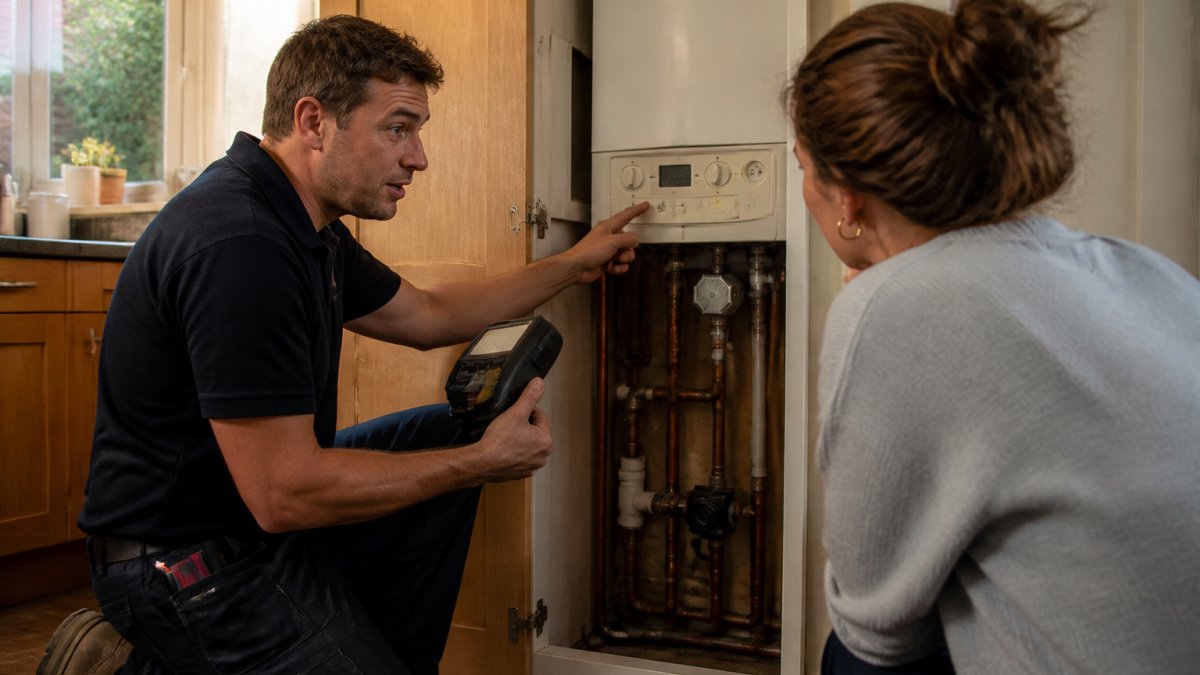
Step 1: Recurring Fault Codes and Boiler Age
Age is the first filter, but recurrence matters more than age alone. A boiler under 8 years old with one fault is usually worth repairing. A boiler over 12 years old with two or more faults in a year is usually not.
- Under 8 years: repair is normally the right call
- 8 to 12 years: weigh the repair cost against a replacement
- Over 12 years: recurring codes point toward replacement
A useful rule of thumb many engineers apply: if the boiler has thrown the same code twice, or two different codes, within 12 months, treat it as a pattern rather than an incident. Patterns on an ageing appliance rarely resolve with one more part.
Step 2: Parts Availability and Engineer Time
The second filter is parts. Older boilers often need parts that are no longer made or are hard to source. That means longer waits and higher costs.
Ask your engineer three questions before authorising a repair:
- Is the part still manufactured, or is it old stock?
- Is it a genuine manufacturer part or a compatible alternative?
- How long is the lead time, and does the boiler stay off until it arrives?
A common mistake is assuming any boiler can be fixed. Some cannot be fixed economically once the maker stops supporting them. If the answer to the first question is "old stock only", the repair is a stopgap, not a solution.
Step 3: Compare the Repair Cost Against Replacement
This is where most guides stay vague. The honest test is a ratio, not a fixed figure: if a single repair is likely to cost a significant fraction of a new boiler installation, and the appliance is already past 12 years, the repair is poor value even when it works.
Work through it like this:
- Get a written diagnosis with the fault code, the failed component, and a fixed repair price.
- Get a written replacement quote for a like-for-like swap.
- If the repair is a large share of the replacement cost and the boiler is over 12 years old, lean toward replacement.
- If the repair is a small share and the boiler is under 8 years old, repair.
A second opinion is cheap insurance here. A different Gas Safe registered engineer may identify a simpler cause, a blocked condensate trap, a seized pump, or low system pressure, that the first diagnosis missed.
Step 4: Factor in Running Costs, Not Just the Fix
An old boiler that is repaired still runs at its old efficiency. A modern condensing boiler recovers more heat from the same gas, so part of the replacement cost is offset over time by lower running costs. The older and less efficient the appliance, the stronger that offset.
This is the part competitors skip: the decision is not repair cost versus replacement cost, it is repair cost plus ongoing running costs versus replacement cost plus lower running costs.
A Worked Pattern
A common pattern is a 14-year-old boiler that throws a fan fault in autumn, is repaired, then throws a pressure or ignition fault the following spring. Each repair looks reasonable in isolation. Together they signal a system at the end of its service life, and the money spent on the second repair would have been better put toward replacement.
Boiler Replacement Cost: What You're Actually Paying For
Boiler replacement cost is not one number. It is a mix of the unit, the labour, and any system work your home needs. We do not quote fixed prices here because every home differs, but you should know what drives the total.
A like-for-like swap costs less than a full system change. A combi replacing an old back boiler, or a system that needs new pipework, costs more.
- The boiler unit itself
- Labour and Gas Safe commissioning
- Flue and pipework changes
- A system flush if sludge is present
- A magnetic filter to protect the new boiler
Get a written quote that lists each of these. A quote without a breakdown is a quote you cannot compare.
Boiler Replacement Grants and Support
Boiler replacement grants can reduce what you pay, but eligibility rules change and amounts are set by the scheme, not by us. Check the official source for current figures before you budget.
In the UK, support has historically come through government-backed energy efficiency schemes. These help with the cost of upgrading to a more efficient heating system for eligible households.
We recommend checking GOV.UK guidance on energy efficiency grants for the schemes open right now. Your installer can also confirm what you qualify for.
Do not assume you are eligible or ineligible. The rules depend on your circumstances and the scheme's current terms.
Combi Boiler vs System Boiler: Which Suits Your Home?
Combi boiler vs system boiler is really a question about your home and your hot water demand. A combi heats water on demand with no tank. A system boiler works with a cylinder to store hot water.
Choose a combi if:
- You have limited space and no loft for a tank
- One bathroom is in use at a time
- You want instant hot water
Choose a system boiler if:
- You have two or more bathrooms in use at once
- You want a cylinder for stored hot water
- You have higher hot water demand
| Feature | Combi Boiler | System Boiler |
|---|---|---|
| Hot water | On demand | Stored in cylinder |
| Space needed | Compact | Needs cylinder space |
| Best for | Smaller homes | Larger homes |
| Multiple taps at once | Limited | Better |
The right choice depends on how your household uses hot water, not on which is "better".
Alternatives to Immediate Repair or Replacement
Alternatives to repairing an old boiler with fault codes do exist, and they are worth knowing before you spend. Not every situation needs a new boiler today, and not every fault code needs a repair this week. Here are the options competitors tend to skip.
Get a Second Opinion Before You Commit
A fault code is a symptom, not a diagnosis. If the first engineer recommends a costly repair or a full replacement, a second Gas Safe registered engineer may find a simpler cause: a blocked condensate trap, a seized pump, low system pressure, or a sensor that needs cleaning rather than replacing. A second opinion costs far less than a replacement and occasionally saves you from one.
Buy Time With Temporary Heating
If the boiler is off and you are weighing your options, you do not have to decide under pressure. Temporary heating options include:
- Plug-in oil-filled radiators for the rooms you use most
- An electric shower or immersion heater for hot water, if your cylinder supports one
- A portable gas heater used strictly to the manufacturer's ventilation instructions
These are short-term measures, not fixes. Treat them as a bridge while you get quotes and make a considered decision.
Use a Service Plan to Spread the Risk
A boiler service plan or home emergency cover spreads the cost of breakdowns across monthly payments and often includes an annual service. For an older boiler, a plan can be a middle path between repairing reactively and replacing outright. Check the terms carefully: plans vary on call-out limits, parts cover, and whether an ageing appliance is excluded after a certain age.
Stage the Replacement Instead of Doing It All at Once
A full system change is not the only route. A staged approach can reduce the immediate outlay:
- Replace the boiler now and keep the existing radiators if they are sound
- Add a magnetic filter and a system flush at the same time to protect the new appliance
- Upgrade controls and thermostatic radiator valves in a later phase
- Plan cylinder or pipework changes for a future year if your system needs them
Staging works best when the existing system is fundamentally sound and only the boiler is at the end of its life.
Fix the System, Not Just the Boiler
Some fault codes are caused by the system around the boiler, not the boiler itself. A system flush removes sludge that causes pressure and circulation faults. A magnetic filter captures debris before it reaches the heat exchanger. Bleeding radiators and resetting pressure can clear codes that look worse than they are. If these have not been done, they are cheaper first steps than a repair.
Check Support Before You Spend
Before committing to a replacement, check whether any current government-backed energy efficiency scheme applies to your circumstances. Eligibility rules and amounts change, so confirm the current position on GOV.UK guidance on energy efficiency grants rather than relying on older figures. Your installer can also confirm what you qualify for.
Our Gas Safe registered engineers diagnose the fault first, then give you honest advice on repair or replace. We cover Glasgow and the West of Scotland, including same-day emergency boiler repair.
If you want a straight answer on whether to repair or replace, Gas Safe Register's find an engineer tool helps you confirm any engineer's credentials before you book.
Frequently Asked Questions
Is it cheaper to repair or replace a boiler that keeps showing fault codes?
It depends on the fault and the boiler's age. A single repair on a boiler under 10 years old is often the cheaper route, but recurring fault codes usually point to deeper wear. Once you're paying for two or three repairs a year, the combined cost can approach a replacement, and you still have an unreliable old boiler. Ask a Gas Safe registered engineer for a written diagnosis and a like-for-like quote before deciding.
Can I get help with the cost of replacing an old boiler?
Boiler replacement grants and support schemes change over time. The Boiler Upgrade Scheme is the main grant for switching to a heat pump, and some energy suppliers offer their own incentives. Eligibility usually depends on your home, your current heating system, and whether you receive certain benefits. Check the current rules on GOV.UK or ask your installer what's available before you commit.
How long does a boiler replacement take?
A straightforward combi swap can be done in a day. If you're changing from a system boiler to a combi, or moving the boiler to a different location, expect two to three days. The engineer will also flush the system, fit a magnetic filter, and commission the new boiler. Ask for a realistic timescale in writing so you can plan around any time without heating or hot water.
What should I check before calling a Gas Safe registered engineer?
Check the boiler pressure gauge (it should read between 1 and 1.5 bar when cold), confirm the thermostat batteries are working, and make sure the gas supply isn't isolated. If the boiler shows a fault code, note it down. If you smell gas, leave the property and call the National Gas Emergency Service on 0800 111 999 immediately. For anything else, a quick check saves you a call-out fee.