 comparison
Boiler Repair or Replacement: Advice and Costs
Table of Contents
- Boiler Repair or Replacement: A Quick Comparison
- Boiler Repair Cost: What You'll Pay and When It Makes Sense
- Signs a Boiler Needs Replacing
- How Long Does a Boiler Last? Age, Lifespan and Efficiency
- Boiler Insurance Cover: Is It Worth It?
- Repair or Replace Decision Tree
- Safety, Legal and Warranty Considerations
- Frequently Asked Questions
Last Updated: October 21, 2026
Boiler Repair or Replacement: A Quick Comparison
Boiler repair or replacement advice usually comes down to one question: is the fault cheap to fix, or are you pouring money into a system that is already failing? At Central Heating Scotland, our Gas Safe registered engineers run that calculation on every callout, and the honest answer is rarely the expensive one.
A repair makes sense when the boiler is under seven years old, the fault is isolated, and servicing has been kept up. Replacement wins when breakdowns keep coming back, parts are hard to source, and efficiency has dropped. Below, we break down cost, lifespan, insurance cover and the safety rules that decide the call.
Boiler Repair Cost: What You'll Pay and When It Makes Sense
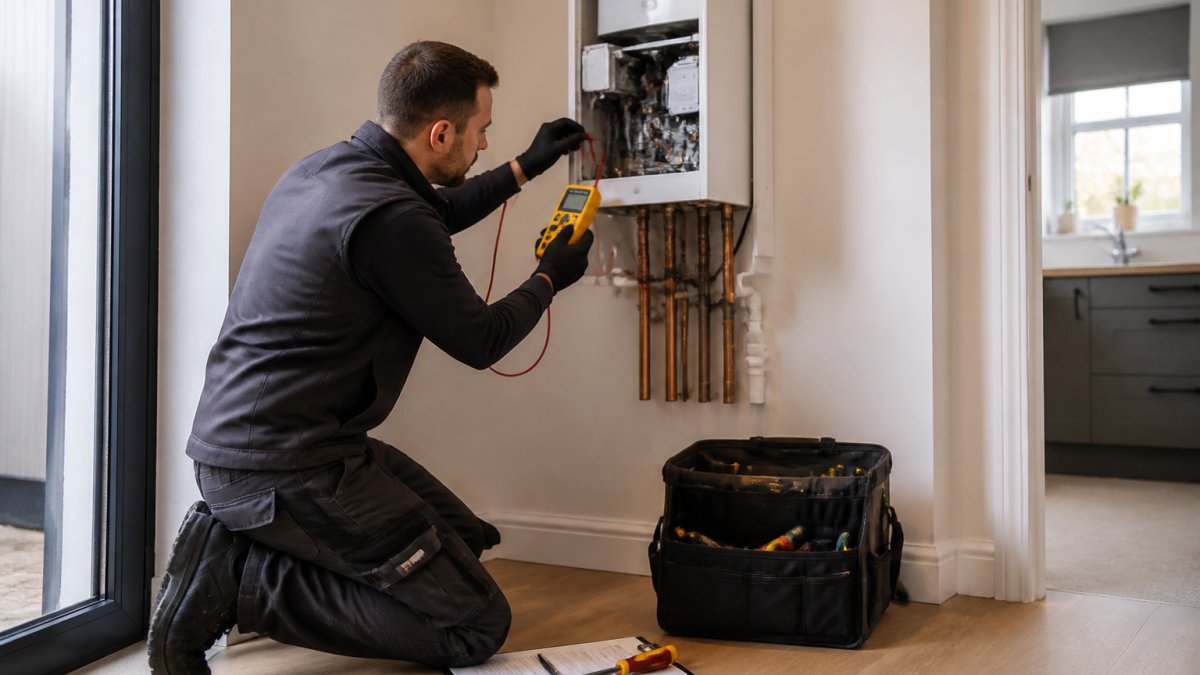
Boiler repair cost depends on the fault, the part, and how long the engineer needs. A thermostat or pressure sensor swap sits at the low end. A heat exchanger, pump or PCB pushes toward the top.
To make the decision concrete, it helps to see typical price bands rather than a single vague estimate. The figures below are indicative ranges for common domestic repairs and will vary with boiler make, access and parts availability, always confirm with a written quote.
| Repair | Typical indicative cost (GBP) | Notes |
|---|---|---|
| Thermostat or pressure sensor | £80-£180 | Often a same-visit fix |
| Diverter valve | £150-£300 | Common on combi boilers |
| Pump replacement | £180-£350 | Labour varies with access |
| PCB (circuit board) | £250-£500 | Part cost dominates |
| Heat exchanger | £400-£800 | Labour-intensive; check warranty first |
A single mid-range repair on a boiler under seven years old is almost always cheaper than replacement. The calculation changes when repairs stack up.
The break-even comparison
A transparent way to compare is total ownership cost over the next few years, not just the immediate bill. Take a boiler at year 12 with a £450 repair quote. Add the likelihood of a second repair within two years, plus the higher running cost of an ageing unit, and the effective annual cost of keeping it can approach or exceed the annualised cost of a replacement spread over its warranty period.
Work through it in three steps:
- Add up likely repairs. Current quote plus any repairs in the last 24 months.
- Estimate efficiency loss. An ageing boiler works harder for the same heat, so running costs creep up.
- Compare against replacement. Divide the replacement quote by its expected service life to get an annualised figure, then compare.
Repair is the right call when the fault is isolated and the boiler is otherwise sound. It stops being cost-effective when the same fault returns, or when two or three repairs land in a single year. That pattern points to a system on its way out.
Signs a Boiler Needs Replacing
The clearest signs a boiler needs replacing are frequent breakdowns, rising energy bills, banging or kettling noises, leaks from the unit, and yellow rather than blue flames. Any of those, combined with age, tilts the decision toward replacement.
Watch for these in particular:
- Breakdown frequency: more than two repairs in a year is a warning
- Falling efficiency: rooms take longer to heat, hot water runs lukewarm
- Visible corrosion or leaks on the casing or pipework
- Yellow flame or sooty marks: a safety issue, not just a nuisance
A yellow flame or sooty staining means you should stop using the boiler and call a Gas Safe registered engineer. That is a carbon monoxide risk, not a maintenance item.
How Long Does a Boiler Last? Age, Lifespan and Efficiency
A well-maintained boiler typically lasts 10 to 15 years. Past that, efficiency drops and spare parts become harder to source, so repair value falls away even if the boiler still fires.
Age is the single strongest signal. Under seven years old and properly serviced, repair almost always wins. Between seven and 12 years, it depends on condition and repair history. Beyond 12 years, replacement usually offers better value for money over the long term.
Parts availability and service support
Lifespan is not only about the metal, it is about whether the boiler can still be fixed. Manufacturers typically support a model with spare parts for a defined period after it leaves production, and once that window closes, a failed component can turn a cheap repair into an impossible one. Before committing to a repair on an older unit, ask the engineer to confirm the part is available and not on extended back order. A boiler that cannot be repaired promptly in winter is effectively a replacement decision made for you.
Warranty status belongs in the same calculation. Most manufacturer warranties require annual servicing by a registered engineer, so a skipped service can void cover on a boiler that would otherwise be repaired free. Check the warranty terms before you authorise any work.
Efficiency, running costs and the environmental angle
Efficiency matters here too. An ageing boiler works harder to hit the same temperature, so running costs creep up year on year. A system upgrade with a modern high-efficiency unit can cut that waste. The Energy Saving Trust guidance on heating your home sets out how heating efficiency affects bills.
There is also an environmental dimension that most advice skips. Extending the life of an existing boiler avoids the embodied carbon of manufacturing and installing a new unit, which is a genuine argument for repair where the fault is minor.
A like-for-like replacement is the straightforward option, but it is worth asking whether a lower-carbon alternative suits the property. Heat pumps and other low-carbon heating systems are increasingly part of the conversation, and a qualified installer can advise on suitability, grants and disruption. That is a bigger decision than a repair, so it belongs in the planning stage rather than the emergency callout.
Household circumstances and disruption
Practical factors tilt the decision as much as the maths. A household with young children or vulnerable occupants cannot afford repeated winter breakdowns, which pushes toward replacement once reliability slips. A tight budget may favour a repair now and a planned replacement later. Seasonal timing matters too: replacing in milder months avoids the disruption of a heating shutdown in cold weather, and installation typically takes a day or more depending on the system.
Boiler Insurance Cover: Is It Worth It?
Boiler insurance cover is worth it for older boilers with a repair history, and poor value for newer ones still under manufacturer warranty. The policy pays for repairs and parts, but exclusions and callout limits decide whether it actually saves you money.
Check three things before you buy:
| What to check | Why it matters |
|---|---|
| Excess and callout fee | Small faults can cost more than paying direct |
| Parts and labour limits | Some policies cap the annual payout |
| Exclusions | Age limits and sludge damage are often excluded |
For a boiler under seven years old with a valid warranty, insurance usually duplicates cover you already have. For a 12-year-old system with a patchy repair history, it can be sensible protection.
Repair or Replace Decision Tree
Work through this decision tree before you commit either way. It turns a gut call into a clear answer.
- Is the boiler under seven years old? If yes, repair, provided servicing is up to date.
- Is the fault isolated and cheap to fix? If yes, repair.
- Have there been two or more repairs this year? If yes, lean toward replacement.
- Is the boiler over 12 years old? If yes, replacement is usually better value.
- Are parts hard to source or on back order? If yes, replace.
- Is there a safety fault, such as a yellow flame or leak? Stop using it and get a professional assessment immediately.
If you reach step 3 or 4 with a yes, get a replacement quote alongside the repair quote and compare long-term costs. A Gas Safe Register engineer search confirms any engineer's credentials before work begins.
Safety, Legal and Warranty Considerations
Safety and warranty rules should shape the decision as much as cost. Gas work must be carried out by a Gas Safe registered engineer, and landlords must hold a valid CP12 Landlord Gas Safety Certificate, renewed annually, for every rented property.
Warranty is the other lever. Most manufacturer warranties require annual servicing by a registered engineer, so a skipped service can void cover on a boiler that would otherwise be repaired free. Before you replace, check whether the fault is still covered.
Our Gas Safe registered engineers handle repair, replacement and landlord certification across Glasgow and the West of Scotland, with same-day emergency response when a system fails. If the fault is major, we tell you honestly whether repair or replacement is the better spend.
Frequently Asked Questions
How do I know whether my boiler needs repairing or replacing?
Start with age and repair history. A boiler under seven years old with an isolated fault is usually worth repairing. If it is over ten years old, breaking down more than once a year, and facing a repair bill that is a large fraction of a new installation, replacement is usually more cost-effective. A Gas Safe registered engineer can give a professional assessment after fault diagnosis, so you get honest advice rather than guesswork. Use our decision tree to weigh age, fault severity, efficiency and running costs before you commit.
Is it cheaper to repair an old boiler or replace it?
It depends on the repair cost relative to a new boiler and the savings from improved energy efficiency. A single minor repair on a well-maintained boiler is almost always cheaper upfront. But repeated repairs on an ageing unit add up, and an old boiler's lower heating efficiency means higher energy bills every year. Add up the repair quote, the likely cost of further breakdowns, and the annual running cost difference. If the total over the next few years approaches the price of a new boiler, replacement offers better long-term value for money.
Does house insurance cover boiler repairs?
Standard home buildings or contents insurance rarely covers boiler breakdowns, and many policies exclude gradual wear and tear. Boiler insurance cover is usually a separate policy or an add-on. Before you buy, check what is included: some policies cover repair costs and parts but exclude the annual service, while others require a service record to keep the cover valid. Compare the excess and the claim limit against the cost of a typical repair. If your boiler is old and unreliable, the premiums may be better put towards a replacement.
How long does a boiler replacement take?
A straightforward like-for-like combi boiler swap usually takes a Gas Safe registered engineer one day. If the new boiler needs a different flue route, a system flush, or a change from a conventional to a combi system, allow two to three days. A full system upgrade with new radiators and controls can take longer. Ask for a written schedule with your quote so you can plan around the disruption, and confirm whether the engineer will leave your heating and hot water working each evening.
When should a brand new boiler be serviced?
Book the first annual service 12 months after installation. Most manufacturers require an annual service by a Gas Safe registered engineer to keep the warranty valid, and the service also confirms the installation is running at its stated energy efficiency. Keep the service record safe because insurers and warranty providers often ask for it. Regular maintenance from year one also makes future fault diagnosis easier and helps you spot a minor issue before it becomes a major breakdown.
When a boiler fails, the pressure to decide fast is real, and the wrong call costs money either way. Central Heating Scotland takes the guesswork out of it: Gas Safe registered engineers, same-day emergency boiler repair, honest repair-versus-replace advice, and full landlord compliance support. Get started with Central Heating Scotland and get a straight answer on whether to repair or replace.