 how-to
Landlord Gas Safety Certificate: A 2026 Guide
Table of Contents
- What Is a Landlord Gas Safety Certificate and Why You Need One
- How Often Gas Safety Checks Are Required
- Understanding the Gas Safety Record (CP12)
- Gas Safety Check Checklist for Landlords
- Landlord Gas Safety Certificate Cost and What Affects Pricing
- Step-by-Step Process: Booking Your Inspection and Receiving Your Certificate
- What Happens When an Appliance Fails or Access Is Unavailable
- Your Legal Responsibilities as a Landlord
- Frequently Asked Questions
Last Updated: October 18, 2026
What Is a Landlord Gas Safety Certificate and Why You Need One
A landlord gas safety certificate is a legal document proving that all gas appliances and pipework in a rental property have been safely inspected by a Gas Safe registered engineer.
Gas safety isn't optional. Carbon monoxide leaks, uncontrolled flames and blocked flues cause serious injury and death every year, and as a landlord you're legally responsible for preventing these risks.
At Central Heating Scotland, we help landlords across Glasgow and West Scotland stay compliant by managing the entire inspection and certification process.
You must provide a copy to every tenant, both new and existing. Failure to do so is a criminal offence under housing law.
How Often Gas Safety Checks Are Required
Gas safety inspections must happen every 12 months without exception (Gas safety checks - who needs them?).
The 12-month period runs from the date of the previous inspection, not the calendar year.
Some landlords believe they can skip a year if nothing went wrong. The law requires annual inspection regardless of the property's history, and only a qualified engineer can identify unpredictable faults.
If a tenant denies access, document your attempts and provide written notice. You're still legally required to pursue the inspection and cannot let a tenancy continue indefinitely without a valid certificate.
Understanding the Gas Safety Record (CP12)
The Gas Safety Record, commonly called a CP12, is the official document issued after a gas safety inspection.
The CP12 records:
- The property address and rental status
- Every gas appliance present (boiler, cooker, fire, water heater, etc.)
- The condition of each appliance (safe or unsafe)
- Pipework and flue condition
- The engineer's name, registration number, and signature
- The date of inspection and expiry date (12 months later)
If any appliance is unsafe, the CP12 will note it clearly. Arrange repairs immediately and obtain a follow-up inspection; an unsafe appliance must be repaired or removed.
The CP12 is a legal requirement. Provide a copy to tenants within 28 days of the inspection, failure is a criminal offence, and keep copies for at least two years.
Gas Safety Check Checklist for Landlords
Before booking your inspection, ensure your property is ready. Here's what a gas safety inspection covers:
- Gas boiler: Combustion analysis, controls, safety devices, pipework connections
- Gas cooker: Burner operation, ignition, controls, gas supply connections
- Gas fire or heater: Flame picture, controls, safety devices, flue condition
- Gas water heater: Operation, safety controls, venting
- Pipework and flues: Condition, ventilation, blockages, leaks
- Meter and regulator: Secure connections, no damage
To prepare your property:
- Ensure access to all gas appliances and clear obstructions around the boiler, cooker or fire
- Have the tenant present or ensure the engineer can reach all rooms
- Provide details of recent appliance work and the previous CP12 if you have one
The inspection duration depends on the number of appliances, as the engineer tests each one, checks for leaks, verifies ventilation and assesses overall safety.
Landlord Gas Safety Certificate Cost and What Affects Pricing
Landlords often ask what a gas safety certificate costs before booking. Pricing depends on the number of appliances, property size, and specific requirements.
The number of gas appliances is the biggest cost driver: a boiler alone might take 20-30 minutes, while a full property with a boiler, cooker, fire and water heater can take 60-90 minutes. Engineers price per appliance or per property, so confirm what's included before booking.
Other factors that affect the final price include:
- Property location: Engineers covering remote or rural parts of West Scotland may add a travel charge; urban postcodes generally attract standard pricing.
- Accessibility: A boiler in a tight cupboard, a flue that requires a ladder, or appliances behind fixed panels can add time and cost.
- Appliance condition: If an appliance fails the inspection, remedial work and a follow-up visit are charged separately. A common pattern is a call-out fee plus parts and labour for the repair, then a re-inspection fee that is often lower than the original certificate price.
- Same-day or emergency booking: Priority slots may carry a premium of £20-£40 over standard rates.
- Landlord bundles: Some engineers offer a discount if you book multiple properties or combine the gas safety check with a boiler service.
For a precise figure, contact Central Heating Scotland with your property details. We provide clear, itemised pricing across Glasgow and West Scotland, with no hidden charges for the certificate or standard documentation.
Step-by-Step Process: Booking Your Inspection and Receiving Your Certificate
This section walks through the full workflow, including the practical points that trip landlords up: tenant access, failed appliances and record retention.
Step 1: Confirm your renewal date and book ahead
Your next inspection is due 12 months from the date on your previous Gas Safety Record, not the end of the tenancy or the calendar year. Diarise the expiry date and book four to six weeks ahead, as Glasgow engineers are busiest before tenancy changeover periods.
When you call, have ready the property address, the number and type of gas appliances, and any access notes (key safe, concierge).
Step 2: Give tenants proper notice and arrange access
You must give tenants at least 24 hours' written notice of the inspection. A text or email is acceptable if it clearly states the date and time window. The tenant must allow access to every room containing a gas appliance, plus the meter and any flue routes.
If the tenant is uncooperative, document every attempt, date, method and response, and send a formal written request. Persistent refusal breaches the tenancy agreement and may need legal advice, but the 12-month deadline does not pause.
Step 3: The inspection itself
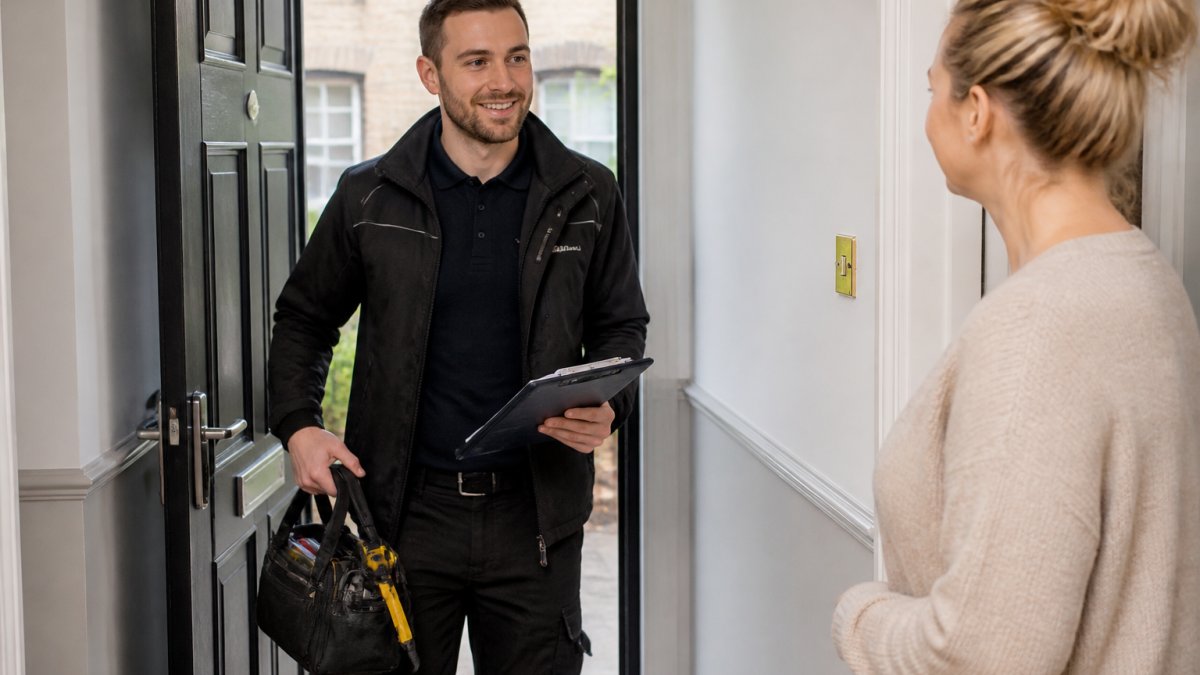
The engineer checks each appliance for safe operation, tests for gas leaks, verifies ventilation and flue performance, examines pipework and the meter, and confirms safety devices such as flame failure devices and carbon monoxide detectors (where fitted) work.
The engineer records the results on the Gas Safety Record as they go.
Step 4: Understand the record before you accept it
When the engineer hands over the CP12, check it lists every appliance, shows the Gas Safe registration number and signature, and states the inspection and next-due dates. If an appliance is missing, ask for it to be added before filing.
Step 5: Distribute copies and file the original
You must give a copy of the Gas Safety Record to each existing tenant within 28 days of the inspection. For new tenants, provide it before they move in or within 28 days of the tenancy starting. Electronic copies are acceptable if the tenant can access and store them.
Keep the original record for at least two years. A simple compliance folder, physical or digital, should hold the current CP12, the previous two years' records, remedial invoices and any access-attempt log, your evidence if a local authority or tenant asks for proof.
Step 6: Plan the next renewal
Set a reminder for 11 months after the inspection date for a month's buffer. For multiple properties, a shared calendar of CP12 expiry dates stops one slipping through; letting agents may offer tracking, but the legal responsibility remains yours.
Central Heating Scotland supports landlords through every step, from booking and access coordination to issuing the CP12 and reminding you when the next inspection is due.
What Happens When an Appliance Fails or Access Is Unavailable
If an appliance is found unsafe, act immediately. The engineer marks it unsafe on the CP12 and you cannot allow the tenant to keep using it.
Your options are:
- Repair the appliance: Arrange a qualified engineer to fix it, then schedule a follow-up inspection to confirm it's now safe
- Replace the appliance: Install a new one and have it certified as part of the follow-up inspection
- Remove the appliance: If repair or replacement isn't viable, disconnect and remove it permanently
You must complete repairs within a reasonable timeframe, typically a few days for critical issues like a faulty boiler. During repairs, provide alternative heating or hot water if necessary.
If a tenant refuses access, document your attempts in writing and send formal notice requiring access.
If access is temporarily unavailable due to the tenant's absence, continue attempting to arrange access and document each attempt. The 12-month deadline still applies.
Your Legal Responsibilities as a Landlord
As a landlord, you have clear legal duties under housing law. You must:
- Arrange an annual gas safety inspection by a Gas Safe registered engineer
- Obtain a valid CP12 within 12 months of the previous inspection
- Provide a copy to all tenants within 28 days of inspection
- Keep records for at least two years
- Ensure all gas appliances are safe and maintained
- Act immediately if an appliance is found unsafe
Failure to comply results in:
- Criminal prosecution and fines up to £6,000 per offence
- Unlimited fines in serious cases
- Potential imprisonment
- Claims from tenants for damages if injury occurs
- Loss of rental income if the property is deemed unfit for habitation
The law doesn't distinguish between negligence and deliberate breach, both carry the same penalties. Even if no accident occurs, missing an inspection is a criminal offence.
You cannot delegate this responsibility to a letting agent or tenant. You are ultimately accountable, regardless of who arranges the inspection. If your agent fails to book the inspection, you're still liable.
Central Heating Scotland removes this burden by managing the entire compliance process. Our Gas Safe registered engineers handle inspections, paperwork and record-keeping, keeping you compliant and protected.
Keeping your rental property compliant with gas safety law protects your tenants, protects you from prosecution, and protects your investment. Central Heating Scotland specializes in hands-off landlord compliance across Glasgow and West Scotland, we handle the inspection, issue the CP12, and manage the documentation so you don't have to worry.
Frequently Asked Questions
How do I get a landlord gas safety certificate?
Contact a Gas Safe registered engineer to arrange an annual gas safety inspection of your rental property. The engineer will inspect all gas appliances, flues, and ventilation, then issue a Gas Safety Record (CP12) certificate on the same day or within a few days. You must provide this certificate to your tenants within 28 days of the inspection. Central Heating Scotland arranges inspections across Glasgow and West Scotland with rapid booking and same-day certification available.
How often does a landlord need a gas safety check?
You must arrange a gas safety inspection at least once every 12 months. The inspection must be carried out before the anniversary of your previous certificate, not after it expires. If you have multiple properties, each one requires its own annual inspection. Keeping a schedule of inspection dates for each property helps you stay compliant and avoid gaps in your legal obligations.
What does a gas safety check include?
The inspection covers all gas appliances in the property (boiler, cooker, fire, water heater), their flues, and ventilation systems. The engineer checks that appliances are safe to use, properly installed, and functioning correctly. They also verify that flues are clear and ventilation is adequate. The engineer documents all findings on the Gas Safety Record (CP12), noting whether each appliance passes or requires repair or replacement.
What should I do if an appliance fails its gas safety check?
If an appliance fails, the Gas Safe engineer will document it on the CP12 as 'Immediately Dangerous' or 'At Risk'. You must not allow the appliance to be used until it is repaired or replaced by a Gas Safe registered engineer. Arrange repairs immediately and obtain a new certificate once the work is completed. Failing to act on a failed appliance puts your tenant at risk and breaches your legal responsibilities as a landlord.