 blog
Need Emergency Boiler Repair Near Me Fast?
Last Updated: October 25, 2026
Quick Summary
An emergency boiler repair near me is a same-day call-out for a fault that leaves your home without heat or hot water, or that poses a safety risk such as a gas smell, leak or carbon monoxide alarm. At Central Heating Scotland, our Gas Safe registered engineers treat these as priority jobs, not routine appointments.
- Call the National Gas Emergency Service on 0800 111 999 if you smell gas near the boiler or meter.
- Check the pressure gauge reads between 1 and 1.5 bar when cold before booking an engineer.
- Stop and call an engineer if your boiler locks out three times after resetting it.
- Ask whether the call-out fee converts into labour if you go ahead with the repair.
- A well-maintained boiler commonly lasts around 10 to 15 years.
Table of Contents
- What Counts as an Emergency Boiler Repair Near Me
- Boiler Not Working Troubleshooting Before You Book
- Leaking Boiler Emergency: Immediate Safety Steps
- How Same Day Boiler Repair Works with Central Heating Scotland
- What a Boiler Repair Cost Actually Covers
- Checking Engineer Credentials and Consumer Protections
- Repair or Replace? Deciding When to Stop Fixing
- Book Your Emergency Boiler Repair
- Frequently Asked Questions
What Counts as an Emergency Boiler Repair Near Me
An emergency boiler repair near me is a same-day call-out for a fault that leaves your home without heat or hot water, or that poses a safety risk such as a gas smell, leak or carbon monoxide alarm. At Central Heating Scotland, our Gas Safe registered engineers treat these as priority jobs, not routine appointments.
The distinction matters because it decides how fast you get help and what you pay. A cold radiator on a mild afternoon can wait. A boiler that has locked out in December with a toddler in the house cannot.
Signs You Should Call an Engineer Immediately
Call an engineer straight away if you notice any of the following:
- A smell of gas anywhere near the boiler or meter. Do not touch switches. Open windows, leave the property and call the National Gas Emergency Service on 0800 111 999.
- A carbon monoxide alarm sounding, or soot staining, a lazy yellow flame instead of a crisp blue one, or unusual condensation on the inside of windows.
- Water escaping from the boiler casing or pipework.
- No heat and no hot water during cold weather, especially in a household with infants, elderly residents or anyone with a health condition.
- A boiler that repeatedly locks out after you reset it.
Watch out: repeatedly resetting a boiler that keeps locking out can mask a serious fault. If it trips three times, stop and call an engineer.
Boiler Not Working Troubleshooting Before You Book
Boiler not working troubleshooting starts with the checks you can safely do yourself in two minutes. Many call-outs end with an engineer finding a switched-off isolator, a tripped fuse or a pressure gauge sitting below one bar. Ruling those out first saves you a wasted visit.
Checks You Can Do Safely in Two Minutes
- Confirm the boiler is switched on at the wall and the programmer or thermostat is calling for heat
- Check the pressure gauge reads between 1 and 1.5 bar when cold
- Look at the display for a fault code and note it down
- Check the condensate pipe outside for ice or a blockage in freezing weather
- Confirm the gas supply is on at the meter and other gas appliances work
- Replace the batteries in a wireless thermostat or smart thermostat
Do not open the boiler casing, touch gas pipework or attempt to relight a pilot light on a modern sealed boiler. Those jobs belong to a qualified engineer.
If those checks fail to fix it, our broken boiler repair service lets you book an engineer who will diagnose the fault properly. For a broader walkthrough of out-of-hours options, see our emergency help guide.
Leaking Boiler Emergency: Immediate Safety Steps
A leaking boiler is a genuine emergency when water is near electrics or the casing itself is wet. Turn the boiler off at the wall, close the water supply valve if you can reach it safely, and place towels or a bucket under the drip. Then call an engineer.
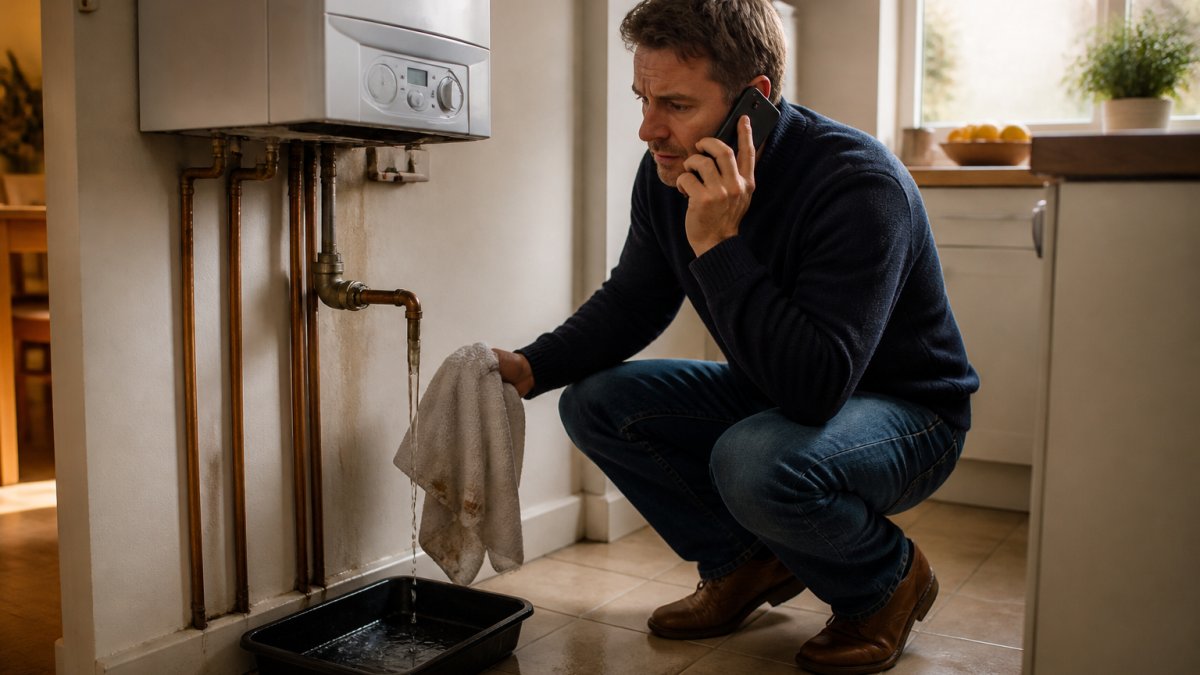
Do not ignore a slow drip. If the leak has left you with no hot water, our hot water repair service covers exactly that scenario.
How Same Day Boiler Repair Works with Central Heating Scotland
Same day boiler repair means an engineer attends and diagnoses your fault on the day you call, then fixes it on the same visit wherever parts allow. Central Heating Scotland runs a booking engine alongside local technical hubs across Glasgow, Renfrewshire, East Dunbartonshire and West Dunbartonshire, so jobs are routed to engineers already working in your area.
Here is how a call-out typically runs:
- You book online or by phone and describe the fault
- We triage the job by urgency and postcode
- An engineer confirms an arrival window
- The engineer diagnoses the fault and talks you through the fix and cost before starting work
- The repair is completed and tested, with any parts replaced explained
If you want to know how long a repair realistically takes, our guide on how quickly a boiler can be repaired sets out the timings.
What a Boiler Repair Cost Actually Covers
Boiler repair cost depends on the fault, the parts needed and how accessible the boiler is, so no honest engineer quotes a fixed figure before seeing the system. What you should expect is a clear breakdown before work starts, and enough detail to compare providers like for like.
A repair quote typically has four elements. Ask how each one is calculated before you book:
| Element | What it includes | What to ask |
|---|---|---|
| Call-out fee | Attendance and initial diagnosis | Is it waived if I proceed with the repair? Is it capped? |
| Labour | Engineer time on the repair | Hourly rate or fixed price? Is there a minimum charge? |
| Parts | Components such as pumps, valves, PCBs or fans | Genuine manufacturer parts? Is there a mark-up on parts? |
| VAT | Tax on the total | Is the quote inclusive or exclusive of VAT? |
How out-of-hours and emergency pricing works
Most firms charge a higher rate for evenings, weekends and bank holidays. A common pattern is a standard call-out fee during weekday hours, a higher fee for out-of-hours attendance, and a separate hourly labour rate that also rises outside normal hours. Some providers charge a single fixed emergency call-out fee that includes the first hour on site; others charge attendance plus labour from the moment the engineer arrives.
Ask three questions before you agree to an emergency visit:
- What is the total minimum I will pay if you attend and diagnose but I decide not to proceed?
- Does the call-out fee convert into labour if I go ahead with the repair?
- Are parts charged at cost plus a mark-up, or at a fixed published price?
What affects the final bill
- Access, a boiler in a tight cupboard or loft takes longer to work on than one with clear space around it.
- Fault type, a failed pump or diverter valve is usually a straightforward swap; a PCB or heat exchanger is more involved and the part costs more.
- Parts availability, a common part held on the van is cheaper and faster than one ordered in, which may add a return visit.
- Age and brand, older or less common models can mean higher parts prices and longer lead times.
If you want to understand how long a repair realistically takes once the fault is diagnosed, our guide on how quickly a boiler can be repaired sets out the timings.
Checking Engineer Credentials and Consumer Protections
Any engineer working on a gas appliance must be Gas Safe registered by law. Ask to see the engineer's Gas Safe ID card and check the licence number on the Gas Safe Register before work begins. The card shows which types of work the engineer is qualified for.
Beyond registration, look for public liability insurance and a written quote. As a consumer, the Citizens Advice guidance on hiring a trader explains your rights if work is faulty or unfinished. Landlords have additional duties: a CP12 Landlord Gas Safety Certificate is a legal requirement, and our team manages that paperwork for letting agents and private landlords as part of our compliance service.
Repair or Replace? Deciding When to Stop Fixing
Repair usually wins when the boiler is under ten years old, parts are readily available and the fault is a single component. Replacement becomes the better call when repairs recur, parts are obsolete, or the boiler is old enough that you are funding repeated fixes on borrowed time. The trick is to apply a few concrete tests rather than guess.
Four tests to apply
1. Age against expected life. A well-maintained boiler commonly lasts around 10 to 15 years. If yours is past ten and has had two or more repairs in the last two years, the economics start to favour replacement.
**2.
3. Parts availability. If the manufacturer has discontinued the part, or it has to be specially ordered with a long lead time, you are one failure away from being without heat again. Obsolete parts are a strong signal to replace.
4. Fault recurrence. One-off component failures, a pump, a diverter valve, a fan, are normal wear and worth fixing. Repeated lockouts, a leaking heat exchanger or a corroded main heat exchanger point to deeper problems that repairs will not solve for long.
Questions to ask the engineer
- What exactly has failed, and is it a wear part or a core component?
- Is the part genuine and currently available?
- How many repairs has this boiler had in the last two years?
- What is the repair cost, and what would a replacement of the same output cost?
- Will the repair be guaranteed, and for how long?
Our boiler replacement service covers full installations across leading brands including Worcester Bosch, Vaillant, Ideal, Vokera and Alpha. We will give you an honest view rather than push the expensive option.
Book Your Emergency Boiler Repair
A boiler breakdown in cold weather is stressful, and the last thing you need is a vague promise and no engineer. Central Heating Scotland provides Gas Safe registered engineers, same-day emergency boiler repair and coverage across all Glasgow postcodes and West Scotland, backed by a straightforward booking process.
Get started with Central Heating Scotland and get an engineer confirmed for your postcode today.
Frequently Asked Questions
Is a leaking boiler classed as an emergency?
A leaking boiler is an emergency when water is pooling near electrics, the leak is from a pressurised component, or you can smell gas. If the water is only a slow drip from a visible pipe, turn the boiler off at the isolation valve and book a same day boiler repair. Never ignore a leak from the boiler casing itself, because it can point to a failed seal or internal part that needs a Gas Safe registered engineer.
How much does emergency boiler repair cost?
Boiler repair cost depends on the fault, the parts needed and whether the call-out is out-of-hours. A simple fix such as a pressure top-up or a replacement valve sits at the lower end, while a failed pump, diverter valve or heat exchanger pushes the bill up. Ask for a diagnostic fee and a written quote before work starts, and confirm whether parts and VAT are included so nothing balloons later.
How quickly can an emergency boiler engineer attend?
Response times vary by provider and postcode. Central Heating Scotland runs same day emergency boiler repair across Glasgow and West Scotland, with rapid triage when you call so the engineer arrives with the likely parts. Remote or rural addresses can take longer than city postcodes, so confirm your service area and expected arrival window when you book rather than assuming a fixed slot.
Can I use my boiler if it is making unusual noises?
Banging, kettling or gurgling noises often point to limescale, trapped air or low pressure, and the boiler can usually stay on while you arrange a boiler service. Switch it off and call an engineer if you hear a loud bang, smell gas, see a fault code with a lockout, or the noise comes with a leak. A Gas Safe registered engineer can diagnose the cause and tell you whether it is safe to keep running.