 comparison
Is a Boiler Service Worth It for Landlords?
Last Updated: November 4, 2026
Quick Summary
A boiler service is worth it for landlords because it keeps the boiler efficient, protects the manufacturer warranty and provides the service records insurers may ask for. The law only requires an annual gas safety check, so treat the boiler service as separate preventative maintenance.
- Landlords must arrange a gas safety check on every gas appliance every 12 months.
- A boiler service is not a statutory requirement, unlike the gas safety check.
- A gas safety check confirms safety but does not clean the boiler or test efficiency.
- Some boiler cover plans charge for the annual service as a separate add-on.
- Manufacturer warranties can be void if the annual service is missed.
Table of Contents
- The Legal Line: What Landlords Must Do and What Is Optional
- Boiler Service vs Gas Safety Check: Why They Are Not the Same
- What a Boiler Service Actually Covers
- Landlord Boiler Service Cost and the Real Return on Investment
- Boiler Cover for Landlords: Insurance, Warranties and What Gets Refused
- Choosing a Gas Safe Registered Engineer and Keeping Digital Records
- Booking Your Landlord Boiler Service with Central Heating Scotland
- Frequently Asked Questions
The Legal Line: What Landlords Must Do and What Is Optional
Every landlord in Scotland faces the same annual question, and the boiler service is usually where it lands. At Central Heating Scotland, we hear it constantly: is a boiler service worth it for landlords, or is the gas safety certificate enough? The short answer is that the law requires one and strongly rewards the other, and confusing the two is the most expensive mistake a landlord can make.
The legal duty is clear. Landlords must arrange a gas safety check on every gas appliance in a rental property every 12 months, carried out by a Gas Safe registered engineer. That check produces the Landlord Gas Safety Certificate, often called a CP12. The Health and Safety Executive guidance on landlord gas safety duties sets out the requirement in full.
A boiler service is not a statutory requirement. But the boiler is the appliance tenants rely on most, and the consequences of a neglected one land on you, not on the certificate.
The Landlord Gas Safety Certificate Explained
The certificate covers appliance safety, not appliance performance. An engineer checks that the boiler, hob, and any other gas appliances are burning safely, that ventilation is adequate, and that no carbon monoxide risk exists.
What the certificate does not do is clean the boiler or test its efficiency. It is a safety inspection, and treating it as maintenance is where problems start. If you want to see what a full compliance visit includes, you can book a landlord safety check and compare it against a service.
Boiler Service vs Gas Safety Check: Why They Are Not the Same
A gas safety check confirms an appliance is safe to use today. A boiler service maintains the appliance so it stays safe and efficient over the year ahead. One is a legal snapshot; the other is preventative maintenance.
The distinction matters because landlords often assume the annual certificate visit covers both. It rarely does unless you specifically book a service alongside it. An engineer conducting a safety check will not dismantle the boiler, clean the combustion components, or run a full flue gas analysis unless servicing is part of the job.
We recommend treating them as two separate diary entries: the certificate for compliance, the service for the health of the asset. For a deeper breakdown of how the two obligations interact, our guide to gas safety compliance versus heating maintenance covers the paperwork and the practicalities side by side.
What a Boiler Service Actually Covers
A boiler service is a structured inspection and clean of the appliance, not a quick visual glance.
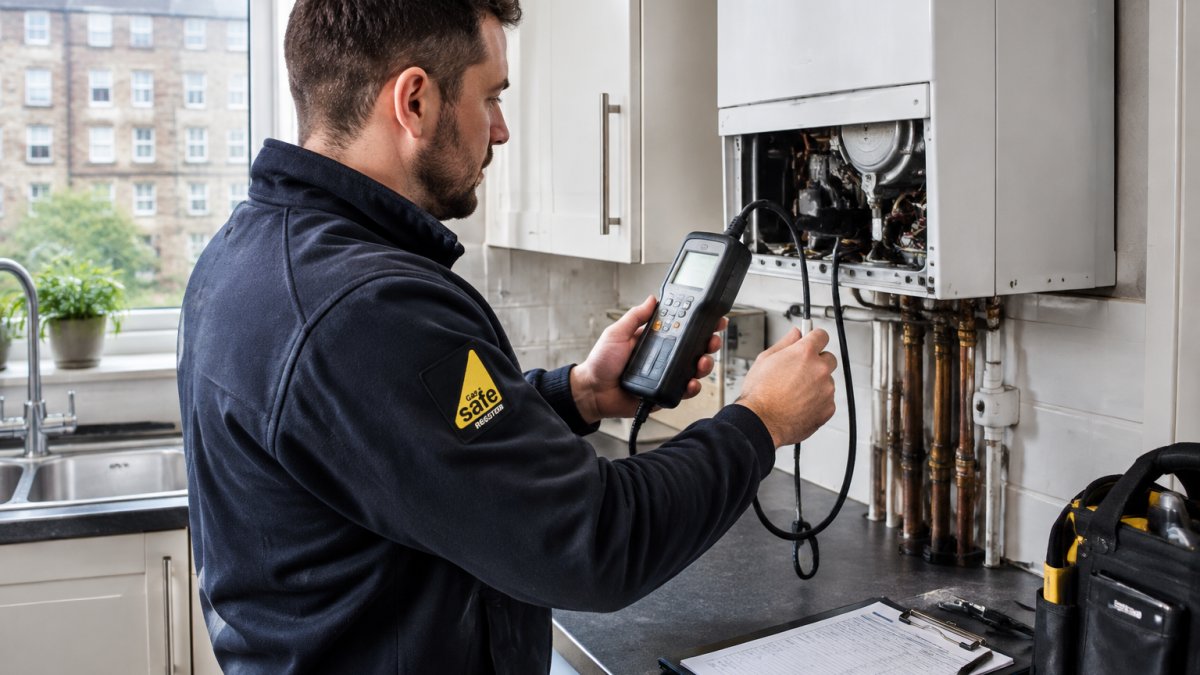
The engineer records what was found and what was replaced. That service record becomes your evidence if a warranty claim or insurance dispute ever arises. When you are ready to arrange one, our boiler service page sets out what the visit involves.
Flue Gas Analysis and Combustion Checks
Flue gas analysis is the part that separates a real service from a token one. The engineer measures the gases leaving the flue to confirm the boiler is burning cleanly and at the efficiency it was designed for. Poor combustion wastes gas, raises tenant bills, and can signal a carbon monoxide risk that a visual check would miss.
A boiler that passes its safety check can still be running inefficiently. Combustion readings catch that drift before it becomes a breakdown or a health hazard.
Landlord Boiler Service Cost and the Real Return on Investment
Here is where the cost-benefit case gets interesting, and where most landlord guides go quiet. What we can do is set out the arithmetic in a way you can apply to your own quotes, because the decision is not really about the service fee, it is about what the service fee prevents.
A routine annual service is a planned, non-urgent visit. An emergency repair call-out is the opposite: premium rates, often out of hours, often with parts marked up and a tenant without heating.
The return on investment has three strands, and it helps to think of them separately:
The Cost of Skipping Servicing
Watch out: if you rely on a boiler cover plan, check whether it includes an annual service or charges it separately, some plans bundle the service, others treat it as an add-on, and assuming it is included is a common and costly oversight.
Boiler Cover for Landlords: Insurance, Warranties and What Gets Refused
| Option | What you get | Best for | Watch out for |
|---|---|---|---|
| Pay-per-service | One-off annual service, no contract | Landlords who prefer control | No breakdown cover included |
| Boiler cover plan | Annual service plus repair protection | Predictable budgeting | Monthly premiums apply whether or not you claim |
| Manufacturer warranty | Repairs covered if servicing is kept up | New boiler installations | Void if the annual service is missed |
How Missing Service Records Affect Insurance Claims
This is the gap most landlord guides leave open. Landlord insurance and home emergency cover are contracts, and insurers assess claims on the evidence you can produce. A documented service history is that evidence. If a claim relates to a boiler failure and you cannot show that the appliance was maintained, the insurer may question the claim, apply an exclusion, or decline it altogether. The policy wording matters more than the marketing: look for conditions that require the appliance to be maintained in accordance with the manufacturer's instructions, and check whether a lack of service records is listed as a reason to refuse a claim.
The practical defence is simple and cheap: keep a folder, cloud-based or otherwise, holding each year's Landlord Gas Safety Certificate, the boiler service record for every visit, the engineer's Gas Safe registration details, and any warranty documents and their servicing conditions. When a tenant disputes safety, an insurer asks questions, or you sell the property, that folder answers everything in minutes. Our guide to compliance with landlord gas safety requirements expands on the record-keeping side for landlords choosing an engineer.
Choosing a Gas Safe Registered Engineer and Keeping Digital Records
Always confirm the engineer is on the Gas Safe Register before any work begins. Ask for the licence card and check the number against the Gas Safe Register itself, not just the van livery. A certificate from an unregistered engineer is worthless and puts you in breach of your legal duty.
Digital record-keeping is the habit that separates organised landlords from reactive ones. Keep a folder, cloud-based or otherwise, holding:
- Each year's Landlord Gas Safety Certificate
- The boiler service record for every visit
- The engineer's Gas Safe registration details
- Any warranty documents and their servicing conditions
When a tenant disputes safety, an insurer asks questions, or you sell the property, that folder answers everything in minutes. Our guide to compliance with landlord gas safety requirements expands on the record-keeping side for landlords choosing an engineer.
Booking Your Landlord Boiler Service with Central Heating Scotland
So is a boiler service worth it for landlords? Yes, and the reasoning is straightforward. The law demands the safety check; good asset management demands the service. One keeps you compliant, the other keeps the boiler running, the warranty valid, and the emergency call-outs away.
Central Heating Scotland provides Gas Safe registered engineers across Glasgow and West Scotland, with same-day emergency boiler repair when something does go wrong. We also handle landlord gas safety certificates. Get started with Central Heating Scotland and put your rental heating on a proper maintenance schedule.
Frequently Asked Questions
Is a boiler service a legal requirement for landlords?
No. The statutory requirement is an annual gas safety check on gas appliances, recorded on a landlord gas safety certificate. A boiler service is not a legal requirement in itself. Many landlords arrange both at the same visit.
What is the difference between a boiler service and a gas safety check?
A gas safety check confirms the appliance is safe to use: it tests for gas leaks, checks ventilation and flue performance, and verifies combustion is within safe limits. A boiler service is deeper maintenance. A boiler service is deeper maintenance than the safety check, which is the legal minimum.
How much does a landlord boiler service cost?
Pricing depends on the boiler type, its condition, and whether you combine the service with a landlord gas safety certificate at the same visit. For a figure specific to your property, request a quote from Central Heating Scotland.
Can a landlord be fined for not servicing a boiler?
A boiler service is not a statutory requirement. A neglected boiler, however, can create tenant safety and liability problems.
Does boiler servicing reduce the risk of breakdowns?
Regular servicing helps show the condition of a boiler over time.