 ultimate-guide
Compliance with Landlord Gas Safety Requirements for Energy Consultancy
Last Updated: October 28, 2026
Quick Summary
Compliance with landlord gas safety requirements means every relevant rental property needs a valid Gas Safety Record (CP12) before a tenant moves in, renewed annually by a Gas Safe registered engineer. The landlord is the duty holder, not the consultancy, and the record must be kept for at least two years.
- The duties come from the Gas Safety (Installation and Use) Regulations, enforced by the Health and Safety Executive.
- Engineers classify defects as immediately dangerous, at risk, or not to current standards, each driving a different response.
- Renewal buffers range from 4-6 weeks for 1-5 properties to 8-12 weeks for portfolios of 20 or more.
- A certificate issued to the agent but never passed to the tenant is a frequent audit gap.
- Most consultancies retain records longer than two years, commonly six years or the life of the tenancy plus a margin.
Table of Contents
- What Energy Consultancies Must Know About Landlord Gas Safety Requirements
- Which Rental Properties and Landlords Fall Under Gas Safety Duties
- Running a Landlord Gas Safety Check That Stands Up to Scrutiny
- Gas Safety Check Frequency: Renewals, Deadlines and Portfolio Scheduling
- Issuing and Tracking the Tenant Gas Safety Certificate Copy
- Managing the Landlord Gas Safety Record as Audit-Ready Evidence
- Edge Cases: Access Refusals, Unsafe Appliances and Wider Obligations
- Booking CP12 Inspections and Compliance Support for Your Portfolio
- Frequently Asked Questions
What Energy Consultancies Must Know About Landlord Gas Safety Requirements
Compliance with landlord gas safety requirements for energy consultancy work starts with one non-negotiable fact: every relevant rental property needs a valid gas safety record before a tenant moves in, and that record must be renewed on a fixed cycle. At Central Heating Scotland, we handle CP12 certificates for landlords and letting agents across Glasgow and the west.
A CP12 is the Gas Safety Record issued after an annual inspection of gas appliances, fittings and flues in rented accommodation by a Gas Safe registered engineer. It documents what was checked, what was found, and whether each appliance is safe to use.
The legal framework behind every CP12
The duties come from the Gas Safety (Installation and Use) Regulations, enforced by the Health and Safety Executive. Landlords must arrange an annual gas safety check on every relevant appliance and flue, keep the record, and give tenants a copy (Gas safety - landlords and letting agents). Guidance from the Health and Safety Executive on landlord gas safety sets out the detail, and the regulations themselves are published on legislation.gov.uk.
For consultancies, the practical point is this: you are not the duty holder. The landlord is. If you want the fuller picture on certification, our landlord gas safety certificate guide walks through the documentation in detail.
Which Rental Properties and Landlords Fall Under Gas Safety Duties
Almost every rented home with a gas supply falls inside the regime. That covers flats, houses, houses in multiple occupation, and social housing, whether let privately or through an agent.
The duty holder is whoever grants the tenancy. Landlords carry the legal duty; letting agents usually manage it on their behalf; tenants have a right to the record and a responsibility to allow access. Static caravans and holiday lets used as accommodation are commonly in scope too, which catches out portfolio owners who assume "not a normal house" means "not covered."
Our guide on gas safety compliance versus heating maintenance explains the topic in more detail.
Running a Landlord Gas Safety Check That Stands Up to Scrutiny
- Confirm the property, access arrangements and which appliances are in scope, including any appliance the tenant owns
- Verify the engineer's Gas Safe registration and that their competence covers the specific appliance type and work
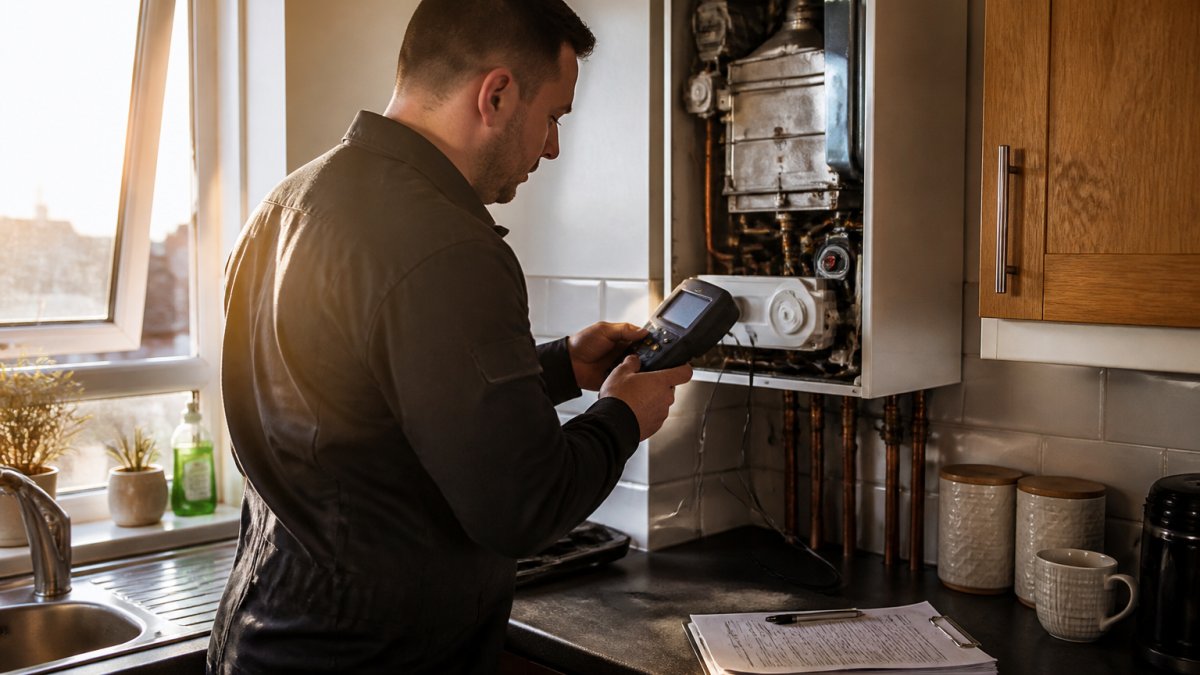
- Inspect each appliance, its fittings and its flue
- Test for gas soundness, combustion performance and adequate ventilation
- Record findings, classify any defects, and issue the Gas Safety Record (CP12)
- Where a defect is found, follow the unsafe-appliance pathway below and record every action
What the engineer inspects on site
The engineer checks gas boilers, gas fires, gas cookers and any other gas appliance, plus the pipework and flues serving them. The check covers appliance safety, gas tightness, combustion, ventilation and the condition of flues. Flues serving appliances in the same room or compartment are also relevant, because a fault in one can affect another.
Defect classification and the unsafe-appliance pathway
When the engineer identifies a problem, the outcome is not binary. In practice, findings fall into three bands that drive different responses:
- Immediately dangerous (ID): a risk to life. The appliance is isolated or disconnected, the supply may be capped, and the tenant and landlord must be told immediately. The record must show what was isolated, why, and what the tenant was advised to do.
- At risk (AR): a defect that could become dangerous. The engineer will usually advise isolation or restricted use and recommend remedial work. The record should capture the advice given and the landlord's response.
- Not to current standards (NCS): the appliance is safe but does not meet current standards. No immediate action is required, but the landlord should be told so they can plan replacement or upgrade.
Where the certificate ends and the evidence begins
If you also want the servicing side handled alongside certification, our boiler service for landlords covers the topic.
Gas Safety Check Frequency: Renewals, Deadlines and Portfolio Scheduling
| Property count | Scheduling approach | Renewal buffer |
|---|---|---|
| 1-5 | Calendar reminder per property | 4-6 weeks before expiry |
| 6-20 | Grouped visits by postcode | 6-8 weeks before expiry |
| 20+ | Rolling annual programme with access windows | 8-12 weeks before expiry |
Issuing and Tracking the Tenant Gas Safety Certificate Copy
Watch out: a certificate issued to the agent but never passed to the tenant is one of the most frequent gaps found at audit, and it is entirely avoidable with a tracked handover step.
Managing the Landlord Gas Safety Record as Audit-Ready Evidence
Two years is the minimum retention period for the gas safety record, and the record must be traceable to the property, the appliance and the engineer who signed it. That is the legal floor. For a consultancy managing a portfolio, the operational standard is higher: you should be able to produce a complete, coherent file for any property within minutes, without depending on an individual's inbox or memory.
What to keep, and for how long
Two years is the statutory minimum for the record. In practice, most consultancies retain for longer, commonly six years or the life of the tenancy plus a margin, because disputes, deposit deductions and insurance claims can surface well after the statutory period. Decide a retention policy, write it down, and apply it consistently across the portfolio. A policy that exists only in one person's habits is not a policy.
Structuring records so they survive an audit
Use one naming convention across every property and every year. An auditor or a court should be able to open a folder and follow the story of a property from first inspection to current date without asking you where anything is.
Demonstrating compliance during an audit or dispute
In practice, the consultancies that survive scrutiny are the ones that can produce a complete file for any property within minutes. That means one system, one naming convention, and no dependence on an individual's inbox.
Edge Cases: Access Refusals, Unsafe Appliances and Wider Obligations
Gas safety also sits alongside wider housing and energy obligations, and consultancies that blur the boundaries create confusion. Keep each duty in its own lane with its own evidence.
Booking CP12 Inspections and Compliance Support for Your Portfolio
Central Heating Scotland provides landlord gas safety services with Gas Safe registered engineers and same-day emergency boiler repair across Glasgow and West Scotland. You can book a landlord safety check directly.
Get started with Central Heating Scotland for landlord gas safety services.
Frequently Asked Questions
What gas safety checks must a landlord arrange?
A landlord must arrange an annual gas safety check on every gas appliance, fitting and flue in the rented property, carried out by a Gas Safe registered engineer. The engineer inspects the appliance for safe operation, checks ventilation and flues, and tests for gas leaks and carbon monoxide risks. The outcome is recorded on a CP12, the landlord gas safety record, which lists each appliance checked, any defects found and the required remedial action. Checks apply to boilers, gas fires, cookers and any other gas fittings supplied with the let.
How often does a landlord need a gas safety check?
Every 12 months. The gas safety check frequency is fixed at annual renewal, and the new check must be completed before the previous certificate expires to avoid a gap in cover. For portfolios, the practical approach is to schedule each property's renewal 4 to 6 weeks before the deadline, so access can be arranged and any remedial work completed without breaching the renewal deadline. A new tenancy does not reset the clock; the existing annual date continues to apply.
How soon must tenants receive a copy of the gas safety record?
New tenants must receive the tenant gas safety certificate copy before they move in, and existing tenants must get a copy within 28 days of each annual check. The copy can be provided on paper or electronically. For energy consultancies managing compliance on behalf of landlords or letting agents, the safest workflow is to issue the copy automatically as soon as the CP12 is signed off, with a timestamped delivery record kept alongside the certificate.
What should a landlord do if a tenant refuses access for a gas safety check?
Keep written evidence of every attempt to arrange access, including dates, times and methods of contact. Explain in writing that the check is a legal requirement and that access is a tenant responsibility under the tenancy agreement. If refusal continues, seek legal advice on the appropriate route, which may include serving notice. Never issue a certificate without a physical inspection. Record the access problem in the compliance file so the audit trail shows the landlord took reasonable steps.
What happens if the engineer finds an unsafe gas appliance?
The engineer will classify the fault and take action to make the appliance safe, which can include disconnecting it or turning off the gas supply to it. The landlord must then arrange repair or replacement before the appliance is used again. The defect and the action taken are recorded on the landlord gas safety record. For consultancies, the priority is to notify the landlord and tenant in writing the same day and log the remedial work through to completion.
Can a landlord let a property without a current gas safety record?
No. Letting a property without a valid CP12 in place breaches the landlord's legal duty and exposes them to enforcement action and penalties. For energy consultancies, a pre-tenancy check should confirm a current certificate is on file before a new tenancy starts. If the certificate is close to expiry, book the renewal before the tenancy begins so the property is compliant from day one and the tenant copy can be issued on time.
The rules are fixed and the cycle never stops, which is exactly why the operational side deserves a system rather than a spreadsheet. If your portfolio is approaching a renewal cluster or you have properties with no confirmed access, talk to us about taking the certification workload off your desk.