 how-to
How to Know If a Plumber Can Fix Your Boiler
Last Updated: October 31, 2026
Quick Summary
A plumber can only legally plumber fix boiler work if they also hold Gas Safe registration, which is required for any work on a gas appliance in the UK. A plumber without gas registration can work on the water side of your heating system, such as pipes and radiators, but cannot open the boiler casing or touch gas pipework.
- Check the back of an engineer's Gas Safe card to confirm they are registered for boiler repair.
- Never remove the boiler casing, touch gas pipework, or relight a boiler that keeps locking out.
- For a gas smell, call the National Gas Emergency Service on 0800 111 999.
- Repair usually wins when the boiler is under about ten years old and the fault is a single component.
- Confirm the engineer is Gas Safe registered, charges are explained upfront, and the firm covers your area before booking.
Table of Contents
- Can a Plumber Fix a Boiler? The Legal Answer
- Who Can Repair a Boiler: Plumber vs Heating Engineer
- Safe Homeowner Checks Before You Call Anyone
- Emergency Warning Signs and When to Call a Professional
- Boiler Repair Cost: What Affects the Bill
- Boiler Repair Time: How Long a Fix Takes
- Boiler Repair or Replacement: How to Decide
- Booking a Gas Safe Boiler Repair Visit
- Frequently Asked Questions
Can a Plumber Fix a Boiler? The Legal Answer
No, a plumber cannot legally fix a gas boiler unless they also hold Gas Safe registration.
A plumber's work on a boiler is only legal when that plumber is on the Gas Safe Register for gas heating work.
The consequences of getting it wrong are serious. The Gas Safe Register official guidance for homeowners is clear that only registered engineers should work on gas appliances.
What a Plumber Can and Cannot Legally Do
A plumber without gas registration can work on the water side of your heating system. That covers pipework, radiators, taps, showers and drainage. They cannot open a gas boiler, adjust the gas supply, or sign off any gas safety work.
The split is simple:
- Plumber, no gas ticket: water pipes, radiators, bathrooms, leaks on the wet side
- Gas Safe registered engineer: anything inside the boiler casing, gas pipework, flues, combustion checks
- Both roles in one person: common, and the ideal setup for a heating firm
A common mistake is assuming "plumber" and "heating engineer" mean the same thing. They overlap, but only one of them can legally open your boiler.
Who Can Repair a Boiler: Plumber vs Heating Engineer
Only a Gas Safe registered engineer can repair a gas boiler. A heating engineer is the person trained and certified for gas appliance work, and the register is the proof.
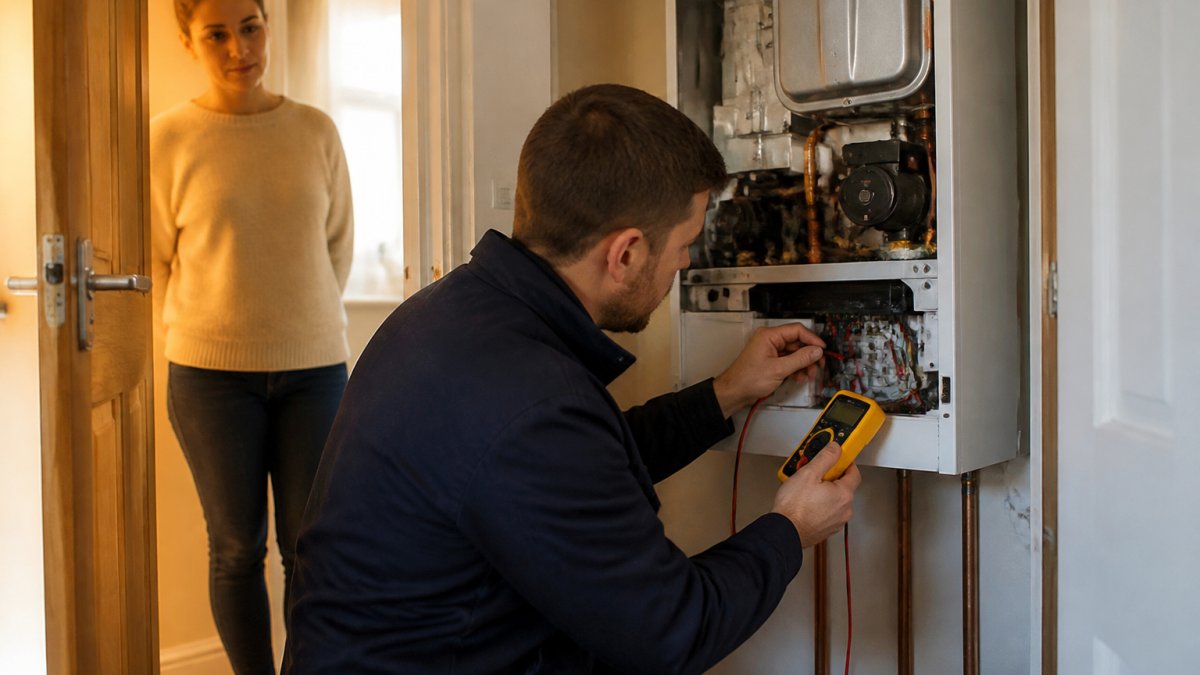
Qualifications and Gas Safe Registration Explained
Gas Safe registration is the legal requirement for anyone working on gas appliances in the UK (Registered Gas Engineer | Regulated Professions Register).
Ask to see that card. Check the back. It lists the scope of their registration, so you can confirm they are covered for boiler repair and not just, say, gas fires.
At Central Heating Scotland, our engineers are Gas Safe registered. You can also book broken boiler repair with the team.
Safe Homeowner Checks Before You Call Anyone
You can safely check a few things yourself before calling an engineer. These checks cost nothing and can save you a callout charge. They also help the engineer diagnose the fault faster.
- Check the pressure gauge. If it sits below the marker on the dial, the system may need topping up. Low pressure is a very common cause of no heating.
- Check the thermostat. Make sure it is calling for heat and the batteries are not flat.
- Check the programmer or timer. A wrong setting is a surprisingly common "breakdown".
- Check the fault code. Note the code on the display before you call.
- Check the power supply. Confirm the boiler has power at the fused spur.
- Check the condensate pipe in winter. A frozen external pipe can stop the boiler. Thaw it gently with warm water, never boiling.
Watch out: never remove the boiler casing, touch gas pipework, or attempt to relight a boiler that keeps locking out. Those jobs belong to a registered engineer.
Emergency Warning Signs and When to Call a Professional
Some faults need an engineer today, not next week. Call immediately if you notice any of the following:
- A smell of gas, or a hissing sound near the meter or boiler
- Soot, scorch marks, or a yellow lazy flame instead of a crisp blue one
- A carbon monoxide alarm sounding
- Repeated lockouts after resetting
- Water leaking from the boiler casing itself
- No heating or hot water in cold weather, especially with a vulnerable person in the home
For a gas smell, do not touch electrical switches. Open windows, turn the gas off at the meter if you can safely reach it, and call the National Gas Emergency Service on 0800 111 999.
Speed matters most when the heating is off and the temperature is dropping. For fast help, see this guide to emergency boiler repair near me.
Boiler Repair Cost: What Affects the Bill
Boiler repair cost depends on the fault, the parts needed, and how long the job takes.
Pricing depends on the fault, the parts required and the time the job takes. For current prices or a quote for your boiler, contact Central Heating Scotland directly.
Factors that can affect the cost of a repair include the fault and parts required.
- The part. A pressure sensor is cheap. A heat exchanger or diverter valve is not.
- Access. A boiler in a tight cupboard, a loft, or behind boxing takes longer to work on.
- Age and brand. Parts for older or less common models can be harder to source and sometimes cost more than the boiler is worth repairing.
- Callout and labour. Emergency, weekend and out-of-hours visits usually cost more, and some firms charge a premium for the first hour.
- Location. Labour rates and call-out fees vary across the country; rural visits can carry a travel element.
- Whether it is a repeat visit. A fault that needs a part ordered means two visits, and some firms charge a return call-out.
Ask for a clear quote before work starts and confirm the engineer is Gas Safe registered for boiler work.
Finally, compare the repair quote against the age and condition of the boiler.
Boiler Repair Time: How Long a Fix Takes
Repair times depend on the fault and on whether the required part is available on the day.
What to expect on the visit:
- The engineer checks your Gas Safe card and asks about symptoms.
- They run fault diagnosis on the boiler and controls.
- They explain the fault and the repair options with costs.
- They carry out the repair and test the appliance.
- They run safety checks and leave you with a record of the work.
Ask for the fault to be explained in plain terms. If it is not, ask again.
Boiler Repair or Replacement: How to Decide
Repair usually wins when the boiler is under about ten years old, the fault is a single component, and parts are easy to get. Replacement can be the better choice when repairs keep stacking up or the same fault returns. If you are leaning toward replacement, see the boiler replacement service to compare options and book. The useful question is not "old or new" but "what does this repair buy me in reliable years per pound?" This boiler repair vs replacement cost guide walks through the decision in more depth.
Use this scored checklist. Give your boiler one point for each statement that is true:
- The boiler is under 10 years old.
- This is the first fault in the last 12 months.
- The same fault has not returned after a previous repair.
- Parts for your model are readily available.
- The boiler is still under manufacturer warranty.
- The quoted repair is a small share of the cost of a new boiler.
- The boiler has been serviced annually and the service record is clean.
- Your running costs and comfort are acceptable.
How to read the score:
- 6-8 points: repair is usually the better value. Book the fix and keep servicing it.
- 3-5 points: borderline. Get the repair quote in writing, ask how long the part is warranted, and compare against a replacement quote before deciding.
- 0-2 points: replacement is usually the better long-term choice, especially if the repair cost is a large share of a new boiler or the same fault keeps returning.
A simple table helps frame the trade-offs:
| Situation | Better choice | Why |
|---|---|---|
| Under 10 years old, first fault | Repair | Cheaper, quick fix, warranty likely intact |
| Same fault returns twice | Replacement | Signals a deeper problem the repair did not solve |
| Parts discontinued or hard to source | Replacement | Repair may not last and the next fault may be unrepairable |
| Repair cost approaching a large share of a new boiler | Replacement | Poor value long term |
| Old boiler with rising running costs | Replacement | Efficiency gains add up over years |
| Boiler still under manufacturer warranty | Repair | Keep the warranty valid with registered servicing |
Two practical points often missed. First, check the warranty terms before authorising a repair: some manufacturers require annual servicing by a Gas Safe registered engineer, and a missed service can invalidate cover. Second, ask whether the repair part carries its own warranty and for how long; a genuine part fitted by a registered engineer usually carries a better guarantee than a pattern part, and that affects the true value of repairing.
Booking a Gas Safe Boiler Repair Visit
Booking the right engineer is the step that protects your home, your warranty and your wallet.
At Central Heating Scotland, we send Gas Safe registered engineers across Glasgow and the West of Scotland, with same-day emergency boiler repair. We also handle landlord gas safety certificates for rental properties.
If you are unsure whether your boiler needs a repair or a replacement, contact Central Heating Scotland to book a visit.
Frequently Asked Questions
Can any plumber repair a gas boiler?
No. A plumber can only work on a gas boiler if they hold the relevant Gas Safe registration for that specific type of gas work. General plumbing qualifications do not cover gas appliances. Anyone working on a gas boiler must be on the Gas Safe Register, and you can check their ID card and licence number before letting them start. If a plumber cannot show valid Gas Safe registration for boiler work, they should not touch the appliance.
What qualifications should a boiler repair engineer have?
A boiler repair engineer should be Gas Safe registered, carry a photo ID card listing the gas work they are qualified for, and have specific boiler and gas appliance competencies rather than general plumbing only. Always ask to see the card and check the licence number on the Gas Safe Register before work begins, especially for landlord gas safety certificates.
How long does a boiler repair usually take?
Boiler repair time depends on the fault and parts availability. Repair time depends on the fault and on whether parts are available on the day. Ask the engineer for an estimate after diagnosis and confirm whether a return visit is needed.
Is it worth repairing an old boiler or should I replace it?
The decision usually comes down to age, condition, and the cost of the fault relative to a new installation. A boiler nearing the end of its typical lifespan, with repeated breakdowns and rising running costs, is often better replaced. A newer boiler with a single repairable fault is usually worth fixing. Ask your engineer for an honest comparison of repair cost against replacement, including efficiency gains and warranty cover.
A boiler that keeps breaking down, a fault code you do not recognise, or a plumber who cannot legally open the casing: these are the moments where the right call matters. Central Heating Scotland provides Gas Safe registered engineers, same-day emergency repair, and honest advice on repair versus replacement across Glasgow and the West of Scotland. Get started with Central Heating Scotland and get your heating back on with an engineer you can verify.