 how-to
What an Ideal Boiler F1 Fault Code Means and How to Fix It
Last Updated: November 10, 2026
Quick Summary
An Ideal boiler F1 fault code means the system has detected low water pressure and has shut the boiler down to protect itself. The boiler has not failed; it has stopped because running with too little water can damage the heat exchanger. The fix is usually topping up the pressure through the filling loop.
- Check the pressure gauge cold: the needle should sit between 1.0 bar and 1.5 bar.
- Open the filling valves slowly, stop in range, then close both valves firmly.
- Never leave the filling loop open or a filling key engaged after topping up.
- Reset only after pressure is back in range, and do not keep pressing reset.
- Call a Gas Safe registered engineer if pressure drops again within days.
Table of Contents
- What the Ideal F1 Fault Code Means
- Reading Your Ideal Boiler Pressure Gauge Correctly
- How to Repressurise an Ideal Boiler
- Resetting Your Ideal Boiler After an F1 Fault
- Why Your Ideal Boiler Keeps Losing Pressure
- When to Stop and Call a Gas Safe Registered Engineer
- Book a Same-Day Boiler Repair
- Frequently Asked Questions
What the Ideal F1 Fault Code Means
An Ideal boiler F1 fault code means the system has detected low water pressure and has shut the boiler down to protect itself. If you are asking what does an Ideal boiler F1 fault code mean, the short answer is this: the boiler has less water inside it than it needs to run safely.
The F1 fault code is a safety feature, not a breakdown. Your boiler has not failed. It has stopped because running with too little water can damage the heat exchanger.
Why Low Pressure Triggers a Boiler Shutdown
A combi boiler needs steady water pressure to move heat around the central heating system. When pressure falls too low, the boiler cannot circulate water safely.
So it locks out. The display shows F1, and the burners stay off until you restore pressure.
This is why the F1 fault code almost always points to one simple job: topping up the system.
Reading Your Ideal Boiler Pressure Gauge Correctly
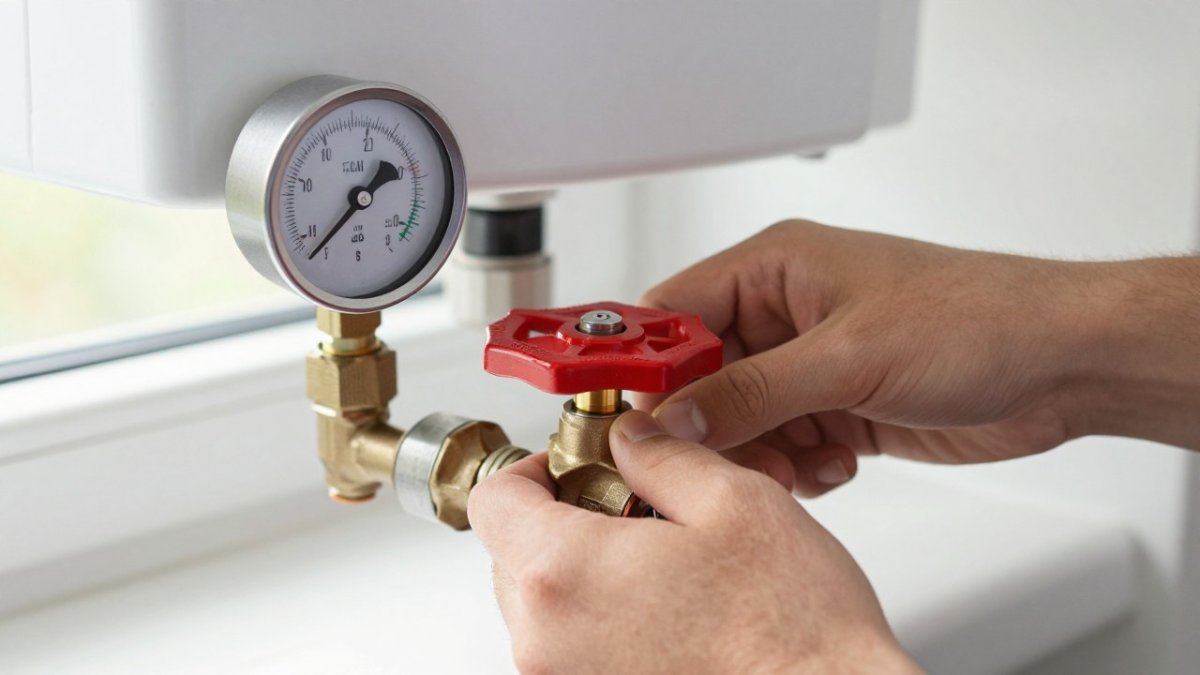
The pressure gauge tells you what the boiler is doing right now. On most Ideal combi boilers it sits on the front panel, marked in bar.
Check the pressure reading before you touch anything. The needle should sit between 1.0 bar and 1.5 bar when the system is cold. Below 1.0 bar, the boiler may throw an F1 fault.
Hot Versus Cold: When to Take the Reading
Always take your pressure reading when the system is cold. Heat makes water expand, so a hot system can read higher than it really is.
A boiler reading 1.8 bar when hot may sit at a healthy 1.3 bar when cold. Judge the pressure cold, every time.
| Pressure Reading (Cold) | What It Means | Action |
|---|---|---|
| Below 1.0 bar | Too low, F1 fault likely | Repressurise the system |
| 1.0 to 1.5 bar | Correct range | No action needed |
| 1.5 to 2.0 bar | Slightly high | Monitor it |
| Above 2.0 bar | Too high | Call an engineer |
How to Repressurise an Ideal Boiler
To repressurise an Ideal boiler, top up slowly through the filling loop with the system cold, stop when the gauge reaches the target range for your model, then close both valves firmly and recheck. The job takes a few minutes, but the exact controls differ between Ideal models, so confirm the filling method in your boiler manual before you start.
Before You Start: The Safety Boundaries
Repressurising through the filling loop is a homeowner task. Gas work in the UK is legally restricted to engineers on the Gas Safe Register, as set out by the Gas Safe Register.
A sensible rule is: you may operate the external filling loop, the pressure gauge and the user reset control. You should not open the casing, adjust the pressure relief valve, or recharge the expansion vessel.
Check the Pressure Cold First
Take the reading with the heating off and the system cold. Heat expands water, so a hot system reads higher than the true cold pressure. A boiler showing 1.8 bar when hot may sit at a healthy 1.3 bar once cold. Judge the pressure cold every time, and top up cold.
Step by Step
- Turn the heating off at the controls and let the system cool.
- Read the gauge and note the cold pressure before touching anything.
- Locate the filling loop or filling key for your model (see below).
- Open the valves slowly, one at a time, and watch the gauge as water enters.
- Stop when the needle reaches the target range in your manual, commonly around 1.0 to 1.5 bar cold on many Ideal combi models, but confirm your model's figure.
- Close both valves firmly, in the reverse order you opened them.
- Recheck the gauge after ten minutes and again the next morning, cold.
Finding and Using the Filling Loop by Model
Filling arrangements vary across the Ideal range, and using the wrong one is where most DIY attempts go wrong.
- Hose-and-two-valve loops. A braided flexible hose beneath the boiler with a valve at each end. Open one valve, then the other slowly, and close both when the gauge is in range. This is the most common arrangement on older combi installations.
- Built-in filling keys. Some Ideal combi models use a removable filling key that seats into a dedicated charging point rather than a hose. The key is turned to admit water and must be removed and refitted to its parking position afterwards. Follow the manual's diagram, because forcing a key or leaving it engaged can cause problems.
- Combined filling and isolation blocks. Certain models group the filling function into a single block with a thumb-turn or lever. The sequence of turns matters, so use the manual rather than guessing.
Because the location and control type differ by model, the safest approach is to identify your boiler's exact model from the data badge, then follow the filling-loop page in that manual.
Watch out: never leave the filling loop open or a filling key engaged after topping up.
What Pressure to Aim For
Do not treat one range as universal. Many Ideal combi boilers are happiest with a cold reading around 1.0 to 1.5 bar, but your manual is the authority for your model. If the cold reading is unusually low (well under 1.0 bar) or unusually high (above about 2.0 bar cold), stop and investigate rather than simply topping up or draining.
After You Top Up
Once the gauge is in range and both valves are closed, follow your model's reset procedure (covered in the next section). Then run the heating and watch the gauge over the next few days. A single top-up that holds is normal. Pressure that falls again within days is a different problem, covered under recurring pressure loss below.
Resetting Your Ideal Boiler After an F1 Fault
Reset the boiler only after the pressure is back in range. Press and hold the reset button for a few seconds, then release. The boiler will run a short check and fire up.
If the F1 fault code returns straight away, the pressure has dropped again. Do not keep pressing reset. A boiler that will not hold pressure has a fault that needs proper fault diagnosis.
Why Your Ideal Boiler Keeps Losing Pressure
An Ideal boiler keeps losing pressure when water escapes somewhere in the sealed system, or when the system cannot hold its charge. A single top-up over months is normal.
The useful distinction is between a one-off drop and recurring loss. A one-off drop often follows a repair, a radiator bleed, or a period of disuse, and settles after one top-up.
What to Do If Repressurising Does Not Clear F1
If you have topped up to the correct cold range and the F1 code is still showing, work through this short flow rather than repeatedly pressing reset:
- Recheck the pressure cold. Confirm the gauge is genuinely in your model's target range and that both filling valves are fully closed.
- Reset once, correctly. Follow your model's reset procedure exactly as set out in the manual.
- If F1 returns immediately, note the gauge reading at the moment it returns. A reading that has already dropped suggests loss; a reading that is in range but the code persists suggests a sensor or control issue.
- Stop resetting. Repeated resets on a fault that will not clear achieve nothing and can mask the underlying problem.
- Arrange professional diagnosis. A Gas Safe registered engineer can test the components that homeowners should not touch.
Common Causes of Recurring Pressure Loss
- Visible leaks at radiators and valves. Look for damp patches, corrosion staining, or weeping at radiator valves and compression joints. These are the most common and most easily fixed.
- Air in the system after a refill. Newly filled systems can read lower once trapped air works its way out. A single re-top-up after bleeding is normal; repeated drops are not.
- A passing pressure relief valve. If the valve has discharged, it can fail to seat properly and continue to pass water to the outside discharge pipe. Look for evidence of discharge near the termination point.
One-Off Drop Versus Recurring Loss
A practical test is to note the cold pressure, top up to target, and recheck cold over the next few days without adjusting anything. A stable reading means the system is holding.
If you have fixed a similar pressure fault on another brand before, our guide to fixing a Vaillant F22 fault code safely walks through the same logic on a different boiler.
When Recurring Loss Needs an Engineer
Recurring loss, discharge from the relief pipe, pressure that climbs above about 2.0 bar cold, or water near the boiler all point to faults inside the casing. These are jobs for a Gas Safe registered engineer. Repressurising is a homeowner task; diagnosing and repairing the sealed components is not.
When to Stop and Call a Gas Safe Registered Engineer
Stop and call a Gas Safe registered engineer if pressure drops again within days, if the gauge sits above 2.0 bar, or if you see water near the boiler.
Working on the gas side of a boiler is legally restricted to Gas Safe registered engineers, as set out by the Gas Safe Register.
You can book an Ideal boiler specialist or browse the full range of boiler fault codes we cover if your display shows something other than F1.
Book a Same-Day Boiler Repair
If your Ideal boiler will not hold pressure, book a same-day boiler repair and let a Gas Safe registered engineer find the cause.
Need urgent help? Read our guide to emergency boiler repair near you, or go straight to our broken boiler repair service.
An F1 fault code is usually a five-minute fix with the filling loop. When it keeps coming back, it is a symptom of a leak that will not fix itself.
Frequently Asked Questions
What pressure should an Ideal boiler be at?
When the system is cold, the pressure gauge should read between 1.0 and 1.5 bar. Once the heating has been running and the system is hot, it may rise to around 2.0 bar, which is normal expansion. If the reading sits below 1.0 bar when cold, the F1 fault code will often appear because the boiler has shut down to protect itself. Check the gauge before you bleed radiators or repressurise, and always take the cold reading as your baseline.
Can I reset my Ideal boiler after an F1 fault?
Yes, but only after you have restored the pressure to the correct range. Resetting without fixing the underlying low pressure will simply trigger the F1 code again. Once the gauge reads between 1.0 and 1.5 bar cold, press the reset button on the boiler display, usually marked with a flame and a circular arrow. Hold it for a few seconds and wait for the boiler to run through its ignition sequence. If the code returns immediately, do not keep resetting it. Call a Gas Safe registered engineer to diagnose the cause.
Why does my Ideal boiler keep showing F1?
If the F1 fault code returns shortly after you repressurise, the system is losing water somewhere. Common causes include a leaking radiator valve, a failed pressure relief valve discharging water outside, a corroded pipe joint, or a faulty expansion vessel that cannot absorb pressure changes. Air trapped in the system can also cause erratic readings. A Gas Safe registered engineer can pressure-test the system, inspect the expansion vessel charge, and locate the leak before it causes further damage.
Is it safe to use an Ideal boiler with an F1 fault?
No. The F1 code means the boiler has shut down because water pressure is too low for safe operation. Running a boiler with insufficient pressure can damage the heat exchanger and other components, and the boiler will not produce heating or hot water anyway. Do not attempt to bypass the fault or keep resetting the boiler without correcting the pressure. If you are unsure how to repressurise your model safely, or if the fault persists, contact a Gas Safe registered engineer.