 how-to
7 Steps to Fix a Vaillant F22 Fault Code Safely
Last Updated: November 8, 2026
Quick Summary
A Vaillant F22 fault code means the boiler has locked out due to low water pressure, and you fix it by repressurising the system through the filling loop until the gauge reads 1.0 to 1.5 bar when cold. Turn the boiler off first, open both filling loop valves slowly, stop at 1.0 to 1.5 bar, close the valves, then reset the boiler.
- Check the pressure gauge with the heating off and the system cold before doing anything else.
- If F22 returns within days of a correct top-up, stop filling and book a diagnosis.
- Do not keep pressing reset to force a locked-out boiler to fire.
- Call 0800 111 999 immediately if you smell gas or a CO alarm sounds.
- Only Gas Safe registered engineers should open the boiler casing or touch gas components.
Table of Contents
- What the Vaillant F22 Fault Code Means and Why It Appears
- Is It Safe to Use a Boiler Showing F22?
- How to Repressurise a Vaillant Boiler
- Vaillant Boiler Reset After F22
- Vaillant Boiler Pressure Too Low: Checking and Reading the Gauge
- Vaillant Boiler Keeps Losing Pressure: What It Means
- When to Stop and Call a Gas Safe Registered Engineer
- Book a Vaillant F22 Diagnosis with Central Heating Scotland
- Frequently Asked Questions
What the Vaillant F22 Fault Code Means and Why It Appears
An F22 fault code on a Vaillant boiler means the system has locked out because it detects low water pressure.
The code appears when the pressure reading drops below the boiler's safe operating range. Vaillant boilers generally need a cold pressure within the range given in the manufacturer's manual.
Why does pressure drop? Water escapes somewhere, or air in the system has been released through bleeding radiators.
Low Water Pressure: The Most Common Cause
Low water pressure is behind most F22 lockouts. A common mistake is assuming the boiler itself is broken. Usually it isn't. The system simply needs topping up, or a leak needs finding.
Check the pressure gauge first. If the needle sits below 1 bar when the heating is off, low pressure is your cause.
Other Causes of an F22 Lockout
Not every F22 is a simple top-up. Other causes include:
- A faulty pressure sensor giving a false low reading
- A blocked or closed filling loop
- A leak on the pipework, radiator valves, or boiler internals
- A failed pressure switch
- Trapped air causing an intermittent fault
If pressure holds after topping up and the code returns within days, something is losing water. That needs diagnosis, not another top-up.
Is It Safe to Use a Boiler Showing F22?
An F22 lockout is a safety shutdown, not a danger signal in itself. The boiler has stopped firing because it cannot confirm safe water pressure, so there is no flame and no hot water production.
The risk is not the code. The risk is what else might be happening at the same time, and whether you keep forcing the boiler to run.
Decide Which Situation You Are In
Work through these in order. Stop at the first one that applies.
**1.
2. Is a carbon monoxide alarm sounding, or does anyone have headache, nausea, dizziness or drowsiness that improves when they leave the property? Treat it as a CO incident.
**3.
4. Is the pressure gauge simply below 1 bar, with no smell, no alarm and no leak? This is the routine case.
**5.
What Not to Do
Do not keep pressing reset to force the boiler to fire.
Watch out: if the boiler has locked out and you can smell gas or a CO alarm is sounding, do not spend time reading the display or looking for the manual, leave the property and call 0800 111 999 first.
If your boiler is locked out and you have no hot water, our guide on how to handle a broken boiler with no hot water covers what to do while you wait for an engineer.
How to Repressurise a Vaillant Boiler
Repressurising a Vaillant boiler means adding water through the filling loop until the gauge reads around 1.0 to 1.5 bar. This is the standard fix for F22 caused by low pressure. It is a task most homeowners can do safely.
You only touch the filling loop and the pressure gauge. You never open the boiler casing or touch gas components. That boundary matters.
Step-by-Step: Filling the System
- Turn the boiler off at the control panel and let it cool.
- Locate the filling loop, usually a braided hose with two valves beneath the boiler.
- Open one valve slowly, then the other, letting water flow in.
- Watch the pressure gauge as it rises.
- Stop at 1.0 to 1.5 bar when cold.
- Close both valves firmly.
- Bleed any radiators that feel cold at the top, then recheck pressure.
- Turn the boiler back on and check the display.
If the code clears and pressure holds, you have fixed it. If F22 returns within days, stop topping up and book a diagnosis.
Vaillant Boiler Reset After F22
A Vaillant boiler reset after F22 is only worth doing once pressure is back in range.
Press and hold the reset for a few seconds, then release. The display should clear and the boiler will attempt to start.
A recurring fault after a correct top-up points to a leak, a sensor fault, or a pressure switch issue. That is engineer territory.
Vaillant Boiler Pressure Too Low: Checking and Reading the Gauge
Reading the gauge correctly is the whole game with F22. The pressure gauge sits on the front of the boiler, usually a small dial or a digital reading.
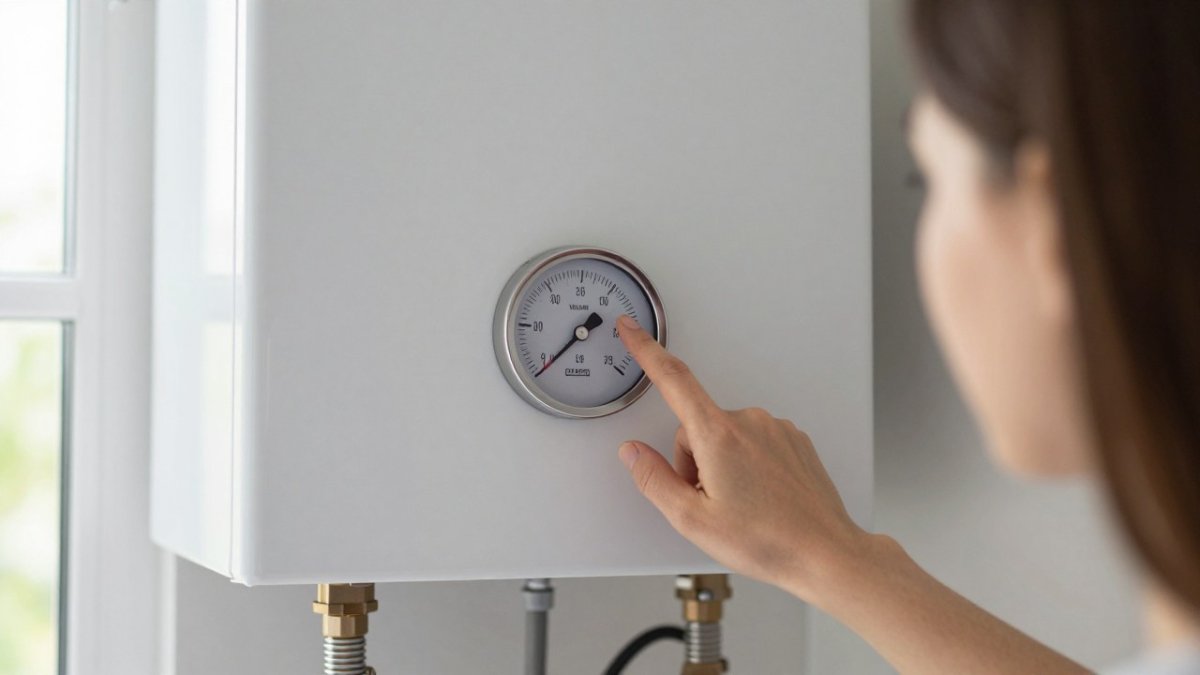
What the numbers mean:
- Below 1.0 bar: too low, F22 likely
- 1.0 to 1.5 bar: correct cold pressure
- 1.5 to 2.0 bar: acceptable when hot, slightly high when cold
- Above 2.5 bar: too high, needs attention
If the needle sits low but the boiler runs fine, the sensor may be misreading. If the needle moves while the boiler runs, that is normal expansion.
Read the gauge with the heating off and the system cold, then match the needle to these bands.
| Gauge reading | What it means |
|---|---|
| Below 1.0 bar | Too low, F22 likely |
| 1.0 to 1.5 bar | Correct cold pressure |
| 1.5 to 2.0 bar | Acceptable when hot, slightly high when cold |
| Above 2.5 bar | Too high, needs attention |
Vaillant Boiler Keeps Losing Pressure: What It Means
A Vaillant boiler that keeps losing pressure has a leak or a component fault, not a filling problem.
Common culprits include:
- A leaking radiator valve or bleed point
- Corroded pipework under floors
- A failed pressure relief valve discharging outside
- A faulty expansion vessel
A common mistake is ignoring a slow pressure loss for months. Small leaks damage pipework and can soak insulation and ceilings. Get it diagnosed early.
Check for damp patches near radiators and look at the pressure relief pipe outside. If it drips, the valve needs attention from a Gas Safe registered engineer.
When to Stop and Call a Gas Safe Registered Engineer
Stop and call a Gas Safe registered engineer when pressure will not hold, F22 returns after a correct top-up, or you see any sign of a leak or gas issue. Gas work is legally restricted to Gas Safe registered engineers, and Vaillant internals are not a DIY zone.
The Stop Signs
Call an engineer if any of these apply:
- F22 returns within days of a correct repressurise
- The gauge will not move when you open the filling loop
- You smell gas, or a CO alarm has sounded
- You can see water damage, damp patches or a dripping pressure relief pipe outside
- The boiler makes banging or kettling noises
- Pressure climbs above 2.5 bar when cold, or the gauge keeps rising on its own
What You Can Safely Check Yourself
There is a clear line between user checks and engineer-only work. You can safely:
- Read the pressure gauge when the system is cold
- Read the display and note any code
- Check the boiler manual for the code definition
- Open and close the filling loop valves
- Bleed radiators with a radiator key
- Check for visible damp near radiators and look at the outside relief pipe
You should not open the boiler casing, touch gas pipework, adjust the pressure switch or sensor, or attempt to replace the expansion vessel. Those are Gas Safe work.
Safe Use While You Wait
If the boiler is locked out and you have booked an engineer:
- Leave the boiler off at the isolator rather than resetting it repeatedly
- Do not block vents or cupboard doors around the boiler
- Use temporary heating that does not rely on the boiler, such as an electric heater, and keep it clear of fabrics
- If you have no hot water, use a kettle or immersion heater rather than running the boiler
- Do not drain the system or remove radiators to 'help'
Watch out: if you smell gas at any point while waiting, stop what you are doing, leave the property and call 0800 111 999, do not wait for the booked visit.
What to Tell the Engineer
A short, accurate brief saves time and money. Have these ready:
- The boiler model and serial number, usually on a data badge underneath or inside the casing flap
- The exact fault code, and whether it is constant or intermittent
- What the pressure gauge reads when cold, and whether it has changed
- Whether you have topped up, how often, and how much
- Whether any radiators have been bled recently
- Any noises, leaks or smells you have noticed
If the code appears intermittently, photograph the display when it happens, a timestamped photo is more useful than a description.
What a Visit May Involve
A Gas Safe engineer will typically check the pressure gauge against a known reference, inspect the filling loop and pressure relief pipe, test the pressure sensor and switch, and check the expansion vessel charge. They may also look for leaks on the pipework and radiator valves.
You can check an engineer's registration on the official Gas Safe Register before any work starts. For a Vaillant specialist to diagnose and fix the fault, you can book a Vaillant boiler repair. If the fault will not clear, our emergency boiler repair service gets an engineer out fast.
You can also look up other codes on our boiler fault code guide if the display shows something different.
Book a Vaillant F22 Diagnosis with Central Heating Scotland
If your F22 will not clear, or pressure keeps dropping, book a diagnosis with Central Heating Scotland.
We offer same-day emergency boiler repair and comprehensive servicing. For landlords, we also handle gas safety certificates.
Get started with Central Heating Scotland and get your heating back on safely.
A recurring F22 is rarely just low pressure. It is usually a leak or a component telling you something.
Frequently Asked Questions
What does the F22 fault code mean on a Vaillant boiler?
F22 on a Vaillant boiler signals low water pressure in the heating system. The boiler has locked out to protect itself because there is not enough water circulating. In most homes the pressure gauge will read below 1 bar. You may also have no heating or hot water. The fix usually involves topping up the system to between 1 and 1.5 bar and resetting the boiler. If the code returns quickly, there is likely a leak or a faulty component that needs a Gas Safe registered engineer.
Can I reset my Vaillant boiler after an F22 fault?
Yes, you can reset a Vaillant boiler after F22, but only after checking the pressure gauge and topping up if it is below 1 bar. Resetting without correcting the pressure will just trigger the fault again. Press the reset button, usually marked with a flame and a crossed-out circle, and hold it for a few seconds. If the boiler fires and runs normally, monitor the pressure over the next few days. Repeated resets without fixing the underlying cause can damage the boiler.
Why does my Vaillant boiler keep showing F22?
A recurring F22 means pressure is dropping faster than it should. Common causes include a leaking radiator valve, a faulty pressure relief valve, a failed expansion vessel, or trapped air in the system. If you top up and the code returns within days or hours, stop resetting and call a Gas Safe registered engineer. A Vaillant boiler that keeps losing pressure needs a proper diagnosis, not repeated top-ups, because the underlying leak or component fault will worsen.
When should I call a Gas Safe registered engineer for an F22 fault?
Call an engineer if the pressure will not stay above 1 bar after topping up, if the code returns within 24 hours, if you smell gas, or if you see any carbon monoxide warning signs such as black soot marks or a yellow flame. Also call if you are unsure how to repressurise your model or cannot locate the filling loop. Gas appliance work is legally restricted to Gas Safe registered engineers, so any repair beyond topping up and resetting must be handled by a qualified professional.